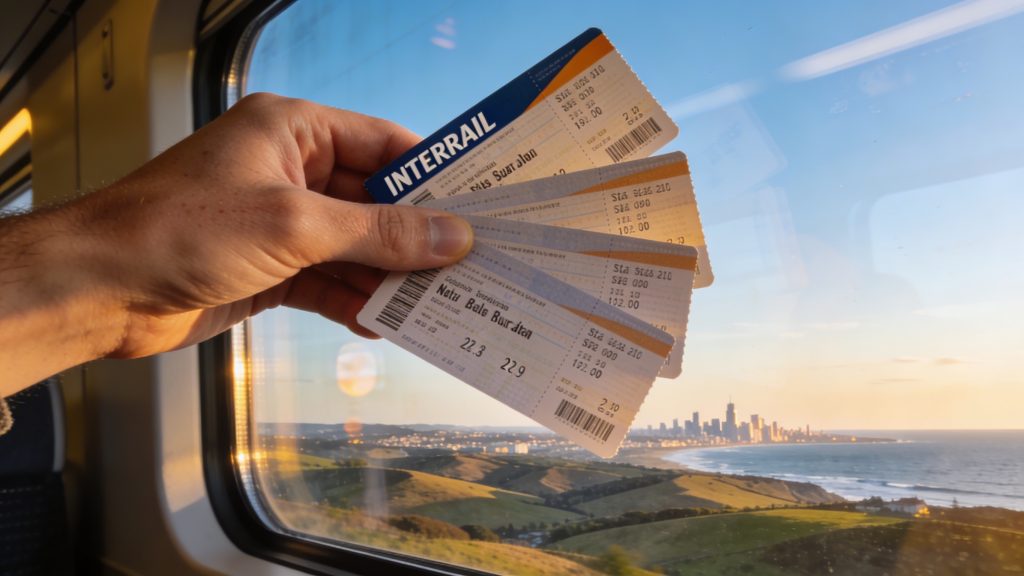
An Interrail Global Pass usually becomes cost‑effective from three or more longer train journeys, with a break‑even point around €185 to €245. Calculate your individual routes in advance and compare this with the cost of a pass to determine which option best suits your travel plan. Do you want to know exactly when you are better off with a pass or with separate tickets?
The choice between Interrail and single tickets depends entirely on how and where you travel. For many travellers a pass offers flexibility and convenience, but sometimes separate tickets are cheaper. With a well‑thought‑out comparison you avoid unnecessary costs. You then consciously choose the option that fits your route. You also consciously choose the option that matches your travel pace.
Perhaps you are planning a train journey through Europe for the first time. Or you are already experienced with Interrail and Eurail rail passes. It pays to put all the costs side by side. In this article we explain when a pass is the smartest choice and when it is better to buy single tickets.
When is an Interrail Global Pass cost‑effective
An Interrail Global Pass is valid in 33 European countries and offers unlimited travel during a specific period. The price varies by age category and travel duration. For young people between 12 and 27 years the pass starts at €185 for four travel days within a month. Adults pay €246 for the same option, while seniors from 60 years pay €221.
The advantages of an Interrail Global Pass become most apparent when you travel on several days in a row. You then change trains regularly. If you cover three or more longer international routes, you will quickly approach the break‑even point. In addition, the pass offers flexibility: you do not have to book every ticket in advance and can travel more spontaneously.
Price overview Interrail Global Pass
- 4 days within 1 month: €185 (youth), €246 (adults), €221 (seniors)
- 7 days within 1 month: €251 (youth), €335 (adults), €302 (seniors)
- 15 days within 2 months: €370 (youth), €493 (adults), €444 (seniors)
- 1 month continuous: €503 (youth), €670 (adults), €603 (seniors)
First class is around 33% more expensive than second class. For most travellers, second class offers sufficient comfort, especially on shorter routes.
<!– wp:acf/onecol {"name":"acf/onecol","data":{"tekst":"","_tekst":"field_64e89c9e13f51","kolombreedte":"9","_kolombreedte":"field_64e89cb413f53","uitlijning":"justify-content-center","_uitlijning":"field_64e89d08cc765","text_white":"","_text_white":""},
<!– wp:acf/onecol {"name":"acf/onecol","data":{"field_64e89c9e13f51":"","field_64e89cb413f53":"11","
Use a calculator for your cost comparison
To determine whether an Interrail Global Pass or single tickets are cheaper, you can use a calculator. These tools compare the costs of your specific routes with the price of a pass. You enter your planned journeys and immediately see which option is the cheapest.
When using a calculator, pay attention to reservation fees. These are not always automatically included in the comparison. Add these costs manually to the price of your pass to get a realistic picture.
Suppose you travel from Amsterdam via Paris and Barcelona to Madrid. Then you travel back again. Add up all the separate ticket prices. Compare this total with the price of an Interrail Global Pass plus the reservation fees for each route. This way you can immediately see which option best suits your budget.
<!– wp:acf/onecol {"name":"acf/onecol","data":{"tekst":"","_tekst":"field_64e89c9e13f51","kolOMBREedte":"9","_kolOMBREedte":"field_64e89cb413f53","uitlijning":"justify-content-center","_uitlijning":"field_64e89d08cc765","text_white":"","_text_white":""},
<!– wp:acf/onecol {"name":"acf/onecol","data":{"field_64e89c9e13f51":"","field_64e89cb413f53":"11","
When to choose single tickets
Single tickets are often cheaper if you only travel one or two specific routes. You then book these tickets months in advance. For travel within Eastern Europe, separate tickets are usually the better choice as well, because prices remain low and early‑bird discounts are not necessary.
Choose single tickets if you
- Travel only one or two routes
- Are mainly in Eastern Europe
- Can book months in advance to benefit from early‑bird discounts
- Make short, isolated trips without extensive onward travel
- Do not travel on high‑speed trains that require reservations
For travellers with a fixed plan and enough preparation time, single tickets are often the most affordable option. You only pay for the routes you actually travel and you do not have to take reservation fees on top of a pass into account.
<!– wp:acf/onecol {"name":"acf/onecol","data":{"tekst":"","_tekst":"field_64e89c9e13f51","kolOMBREedte":"9","_kolOMBREedte":"field_64e89cb413f53","uitlijning":"justify-content-center","_uitlijning":"field_64e89d08cc765","text_white":"","_text_white":""},
Is an Interrail Pass always the most cost‑efficient option for my planned train journey through Europe?
An Interrail Pass is not always the most cost‑efficient option; that depends on your route, number of travel days and how early you book. If you travel often, through several (expensive) countries and want to stay flexible, Interrail is usually more advantageous. If you only make one or a few specific journeys and can book early, single tickets are often cheaper. That’s why you should compare the total price of single tickets with the price of the appropriate Interrail Pass, including any reservation fees.
Which specific route and travel‑duration factors influence the cost comparison between Interrail and single tickets?
Specific route factors include whether you mainly visit expensive countries (such as Switzerland and France) with high base fares and compulsory reservations, or rather cheaper countries (such as many Eastern European countries) with low single‑ticket prices. Travel‑duration factors are the number of travel days within a given period (e.g. 4 or 7 days in a month), how closely your travel days are grouped together, and whether you make long international journeys or mainly short regional trips. It also matters whether you can book early (which often makes separate international tickets much cheaper) or mostly travel last minute (in which case Interrail becomes relatively attractive). Finally, compulsory reservations on fast international routes (Thalys, Eurostar, TGV) influence the comparison, because these surcharges are added on top of both single tickets and an Interrail pass.
How can I smartly factor hidden costs such as seat reservations and surcharges into my total budget overview?
Create a separate budget line called “reservations & surcharges” and enter a rough estimate per travel day there (for example €10–€30 per long journey in Western Europe). Check in advance for each country/route whether reservations are compulsory and note the specific amounts (Thalys, TGV, Eurostar etc. are often an extra €20–€40). Add these in advance to the price of your pass or single tickets, so you always calculate with an “all‑in” daily average. After each journey, review your actual costs and adjust your remaining daily budget accordingly.
Besides financial considerations, does an Interrail Pass also offer enough flexibility and comfort for my travel style?
Yes, an Interrail Pass generally offers a lot of flexibility, because you can choose freely between trains on several days within a month (or longer), which suits a spontaneous or changeable travel plan. You are not tied to pre‑set routes or times, which is useful if your itinerary is not completely fixed yet. Comfort mainly depends on the countries and railway companies you travel with, but regular long‑distance and international trains in Europe are generally comfortable. Do bear in mind possible compulsory reservations for high‑speed and international trains, which can slightly limit your flexibility.
Are there discount periods or early‑bird discounts for single tickets that make an Interrail Pass less attractive?
Yes, many railway companies offer early‑bird discounts and promotions for single (supersaver) tickets, especially on popular international routes such as Amsterdam–Paris or Amsterdam–Berlin. These offers can make single tickets significantly cheaper than the standard day price and in some cases also cheaper than an Interrail Pass, especially if you only travel one or two routes. In countries such as France and Germany the price differences between early‑bird and last‑minute tickets are large, which means that well‑planned single tickets are often more attractive financially. In countries without, or with limited, early‑bird discounts (such as Switzerland), an Interrail Pass usually remains competitive.

 NL
NL