 NL
NL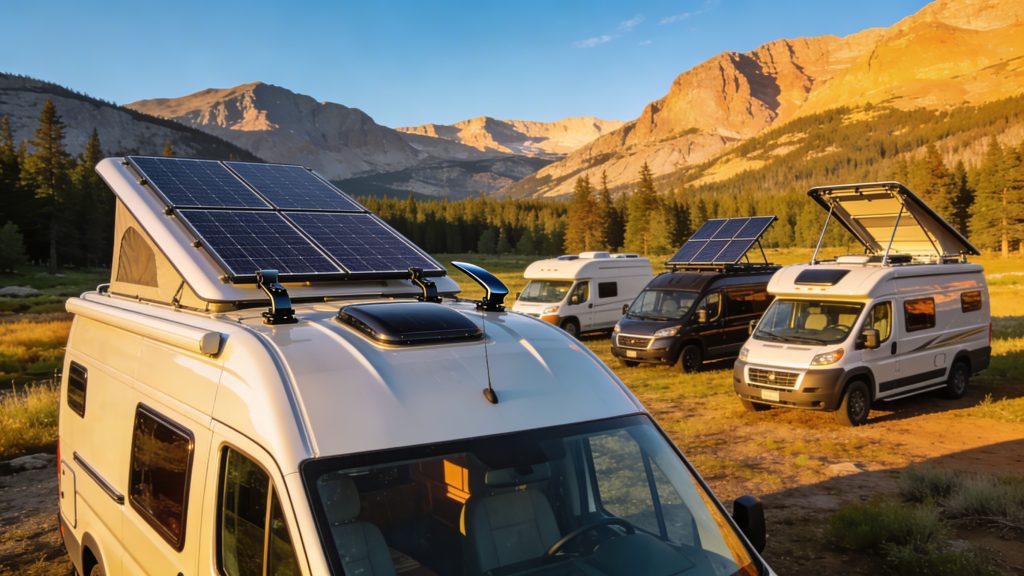
A panel van has limited roof space and requires compact solar panels of up to 200W, whereas an A-class motorhome offers room for 400W or more, making it possible to camp off-grid for days. The difference between motorhome types not only determines how much power you can install, but also which type of panel will perform best. That way you choose smartly and camp self-sufficiently.
Why the type of motorhome is decisive for your choice
The roof surface and shape of your motorhome directly determine how many and what type of solar panels you can install. A compact van conversion has less space than a large A-class motorhome, and a slightly curved roof requires different panels than a flat surface. The aim is to achieve enough power for your daily electricity use without overloading the motorhome or compromising its handling.
Besides the available space, your travel style also plays a role. If you mainly stay on campsites with electric hook-ups, a small system will cover your basic needs. If you plan longer off-grid trips in remote areas, you will need more power. The climate along your route is also relevant: in northern Europe, where the weather is often cloudy, you have different requirements than in sunny southern regions. For all motorhome types, a good match between roof space, power and panel type makes the difference between basic and comfortable camping.
‘ On white panel vans, bifacial panels (panels that capture light on both sides) perform better than traditional panels. ’
Panel van: compact solutions for limited roof space
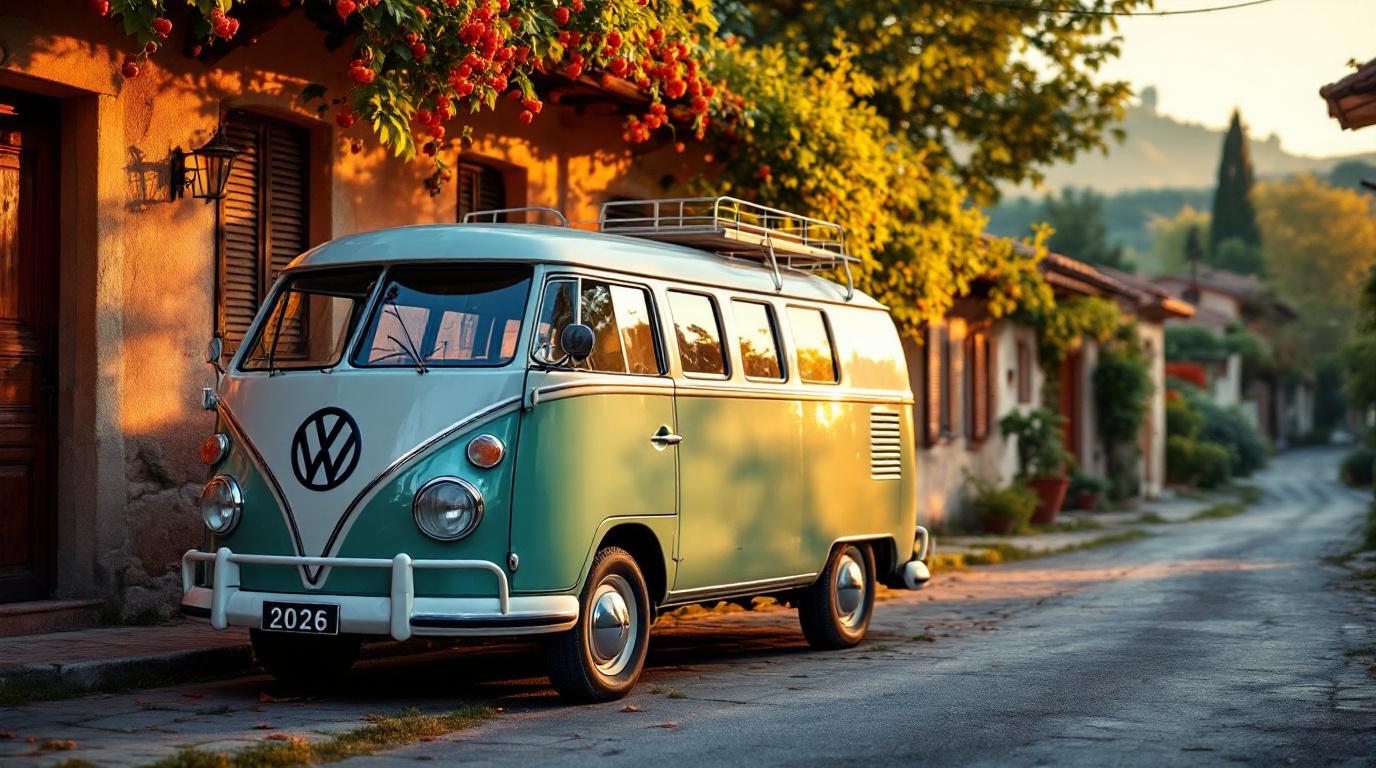
A panel van such as the Fiat Ducato generally has a roof area that offers space for 100 to 200W of solar panels. Because of the limited space and sometimes slightly curved roof shape, semi-flexible panels are often the best choice. These panels are lighter than traditional glass panels, stick directly to the roof without mounting brackets and can flex slightly with the surface.
A system of 100 to 175W produces around 40 to 70Ah on a sunny day, enough for a fridge, fan and lighting. For those who camp off-grid more often, 200W is recommended. This can be achieved with two smaller 100W panels or one larger panel, depending on the available roof space. Semi-flexible panels weigh roughly 2 to 3 kilos less per 100W than glass panels, which is beneficial for the overall weight of the motorhome.
On white panel vans, bifacial panels (panels that capture light on both sides) perform better than traditional panels. These panels capture light on both sides and benefit from reflection off the white roof. In cloudy weather they deliver up to 20 to 30 per cent more output. This makes them interesting for trips to regions with changeable weather, such as Scandinavia or the Alps.
Overcab motorhome: more space for robust systems
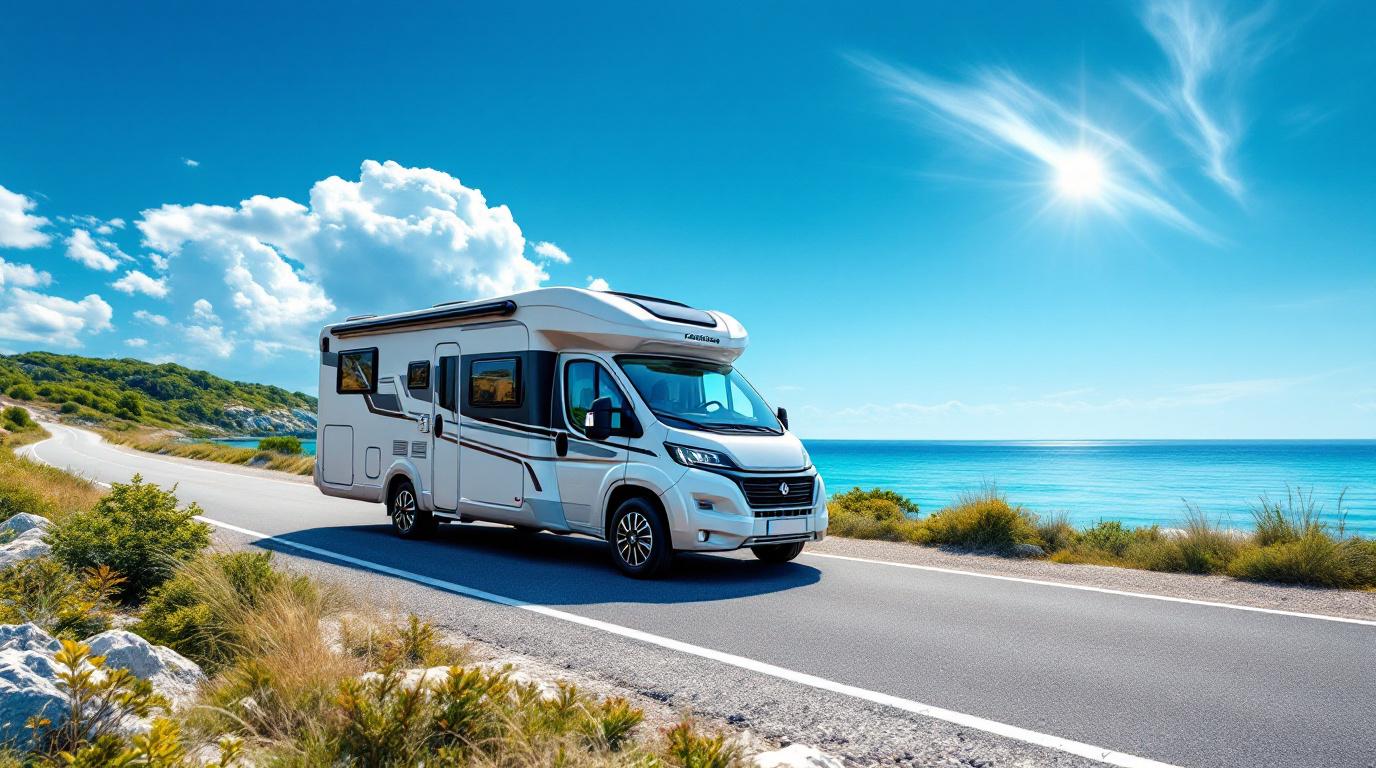
An overcab motorhome has a larger and flatter roof than a panel van and offers space for 200 to 300W of solar panels. Thanks to the flat surface, glass panels are very suitable. These solid, robust panels have a high output and last more than 20 years. They are heavier and require mounting brackets, but offer stability and efficiency.
For those who take longer trips to sunny destinations such as southern Europe, monocrystalline glass panels (panels with higher efficiency per surface area) are a good choice. They are more efficient than polycrystalline variants and perform better in variable weather. A 200 to 300W system generates enough power for cooling, lighting and charging points, even with average sunlight.
Motorhomers who do not install fixed panels or who rent their motorhome often choose mobile or folding panels. You place these next to the motorhome when you are parked for longer. The downside is that the output is lower in shade and that you have to unfold the panels and point them at the sun manually.
A-class motorhome: maximum power for off-grid freedom
An A-class motorhome offers the largest roof area and makes it possible to install 300 to 400W or more. This amount of power supports extended off-grid camping with the use of larger consumers such as a compressor fridge, air conditioning or multiple charging points. The spacious, flat roof is suitable for both glass panels and combinations of fixed and semi-flexible panels.
Motorhomers who often camp in remote areas benefit from a 400W system. On a sunny day this delivers 140 to 160Ah, enough for several appliances and longer periods without sunlight. Combine this with extra batteries for storage, so that at night you can fall back on stored energy.
On A-class motorhomes you can also install tiltable panels. This increases the output in northern destinations where the sun is low in the sky. A tiltable system requires more installation effort. With optimal alignment it delivers up to 20 per cent more power. For those who regularly travel to Scandinavia or northern mountain regions, this is worth considering.
‘ An MPPT controller adjusts the voltage and ensures the highest yield. ’
Calculating power and connecting it to your system
The amount of power you need depends on your consumption. A standard fridge uses about 30 to 50Ah per day, a fan around 10 to 20Ah and lighting 5 to 10Ah. Add up your daily consumption and add a 20 to 30 per cent margin for less sunny days. This gives you a realistic power requirement.
In the Netherlands and similar climates, solar panels achieve on average 70 per cent of their peak power. A 200W panel therefore delivers about 140W under normal conditions. Take this into account when sizing your system. In sunnier regions such as Spain or Italy, the output is higher, and in more northern areas it is lower.
For the connection you use an MPPT charge controller. This device regulates the charging current to your batteries and maximises the efficiency of the panels. An MPPT controller adjusts the voltage and ensures the highest yield. With several panels you connect them in parallel to prevent overvoltage. The controller makes sure the batteries are automatically charged until they are full.
Practical considerations for installation and use
The positioning of solar panels affects their output. Ideally, they should be at a 90-degree angle to the sun, but on a motorhome this is often not feasible. A flat installation on the roof still provides good efficiency in direct sunlight. It is important that panels are free from shade caused by trees, buildings or roof equipment such as bike racks or aerials.
Lightweight panels have the advantage of adding less weight and causing no wind noise. Semi-flexible and bifacial panels weigh 2 to 3 kilos less per 100W than traditional glass panels. This makes a difference on motorhomes where every kilo counts towards the maximum payload. Light panels also do not require additional brackets, which makes installation easier.
The maintenance of solar panels is limited but still important. Keep panels free of dirt, leaves and snow. Contamination can reduce output by 10 to 20 per cent. A regular clean with water and a soft cloth is enough. Make sure panels are not damaged when driving under low branches or other obstacles.
Sustainable camping with solar panels
Solar panels make extended off-grid camping possible without depending on campsites or running the engine to generate power. This not only makes travelling more comfortable, but also more environmentally friendly. Glass panels last more than 20 years, while semi-flexible panels have a shorter lifespan but still offer enough output for intensive use over several years.
For routes through areas with changeable weather, such as the Alps or Scandinavia, a combination of fixed and mobile panels is useful. Fixed panels supply power continuously, and you can place mobile panels on the ground at longer stops to generate extra power. This gives you flexibility and increases your independence.
Several factors play a role when choosing solar panels: the type of motorhome, the available roof space, your travel style and the climatic conditions at your destination. With the right combination of panels and a properly sized battery bank, you will get more out of your motorhome holidays and enjoy more freedom on the road.
On the Traveler Tips website you will find much more information about motorhome holidays, from practical tips on equipment and planning to routes and destinations. Discover more and plan your next trip with reliable, in-depth information.
Frequently asked questions
For a small panel van or campervan, semi-flexible or bifacial panels of 100–175W are ideal: lightweight, they follow the slightly curved roof and make good use of white roofs. For larger overcab or A-class motorhomes, fixed (mono) glass panels of 200–400W are the most suitable, thanks to their high output and ample flat roof area. If you travel off-grid a lot with higher power demand (compressor fridge, fan, laptop), aim for around 200W total power with an MPPT controller and, if needed, an extra habitation battery. For varying pitches or hire motorhomes, you can (also) use mobile/folding panels so you can still place them optimally in the sun at shady spots.
First determine your daily consumption: add up the power (W) of all your appliances × the number of hours used per day and divide by 12V to get your required Ah per day. Then choose a habitation battery that can supply at least 2–3 days of this usage (taking into account a maximum 50% discharge for lead-acid batteries or 80–90% for lithium). Next, calculate your panel power: divide your daily Wh requirement by the number of effective sun hours (in the Netherlands roughly 3–4 hours in summer, 1–2 in spring and autumn) and add 30–40 per cent to account for losses. For comfortable, largely independent travelling this often comes down to around 200W for an average motorhome, and 300–400W plus a larger battery if you want to stay off-grid longer or have many power-hungry appliances.
Fixed glass panels are robust, relatively cheap per watt and have a long lifespan, but they are heavier, rigid and require a flat roof and mounting brackets. Flexible panels are lighter, follow a (slightly) curved roof and are less conspicuous, but they are more expensive, more sensitive to wear and usually do not last as long. If you travel off-grid a lot, spend long periods in sunny regions and have enough flat roof space, fixed glass panels generally suit you better, especially if your budget is limited. If you have a panel van with a curved roof, want to keep weight and height down or value a sleek, discreet installation, (semi-)flexible panels are often the best choice despite the higher price.
You can install solar panels on your motorhome yourself by first calculating your power needs (in Ah/Wh), selecting suitable panels (e.g. 100–200W for a panel van, 300–400W for a large A-class) and connecting them according to the wiring diagram to an MPPT charge controller and your leisure battery using the correct cable sizes and fuses. Mount glass panels with roof brackets or bond semi-flexible panels directly onto the (slightly curved) roof, and make sure all cable entries are properly routed and watertight. Maintenance mainly consists of regularly cleaning the panels (removing dirt and snow) and checking cables, connectors and fixings once a year for wear and corrosion. You can find reliable professional help via specialist motorhome companies and solar panel installers with motorhome experience (check reviews and motorhome forums), or get advice from recognised brands such as Victron dealers for a complete system.
Weather conditions such as hours of sunshine, cloud cover, temperature and shade directly determine how much light your panels convert, with cool, clear days often being more efficient than extremely hot ones. Your travel route mainly affects the total solar irradiation: southern, sunny regions and open plains produce significantly more power than northern areas, forests or mountain valleys with lots of shade. You can optimise by planning your route (as far as possible) through sunny regions and seasons and parking your motorhome so the panels face the sun as much and as squarely as possible. Ideally use an MPPT charge controller, keep your panels clean and consider tiltable or (additional) mobile panels to respond better to changing weather and parking situations.