NL
NL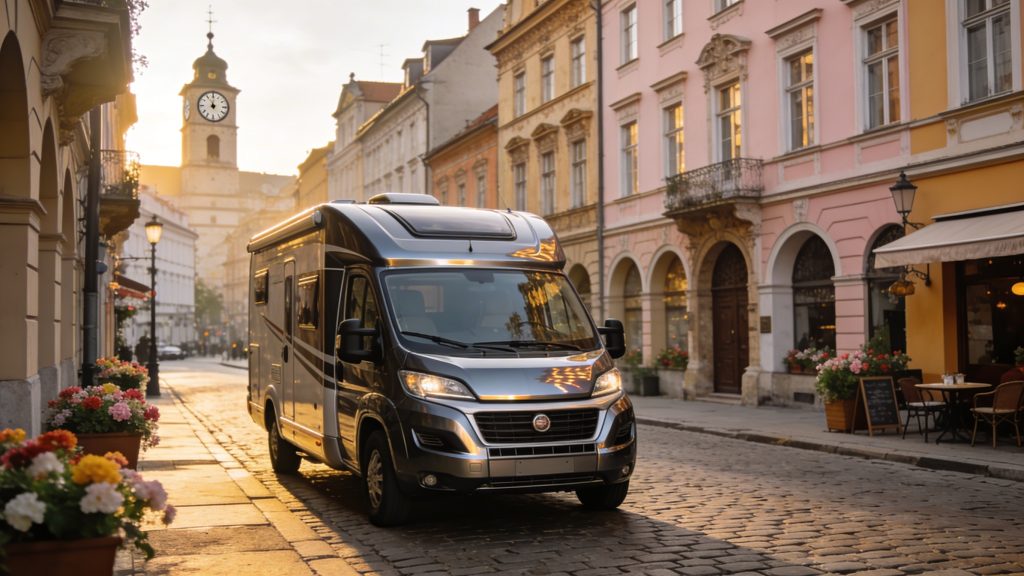
The compact campervan offers the perfect combination of manoeuvrability and living comfort for city breaks, allowing you to explore busy city centres such as Rome or Lisbon just as easily as a remote nature reserve. Thanks to its slim design this camper fits into standard multi‑storey car parks, handles narrow streets with ease and attracts less attention than larger models. Discover how a campervan can make your city trip more comfortable and flexible.
Why a campervan is ideal for city visitors
A campervan drives like a larger car, and you notice that immediately when you head into a city. The compact dimensions give you much more control in heavy traffic than traditional motorhomes do. You steer smoothly through narrow streets where bigger models cannot even begin to go.
The big advantage is parking. Multi‑storey car parks with a minimum height of 2 metres are accessible, which often means you can park centrally. This saves you both time and money on public transport. On top of that, the campervan fits into regular parking bays, so you are not dependent on special motorhome spaces.
Besides the technical benefits there is also the discreet appearance. A campervan stands out less than a full coachbuilt motorhome. This gives you more freedom when choosing an overnight spot and makes it easier to move among other traffic. There are different types of motorhome, but in terms of agility in urban environments the campervan is unbeatable.
‘ You can stand upright while cooking or getting dressed, which makes your stay much more pleasant. ’
Pop‑top for extra space
A campervan with a pop‑top or elevating roof combines the best of both worlds. While driving you keep the compact dimensions, but once parked you lift the roof for extra standing room and a double bed. This type is perfect if you are travelling with two to four people.
The elevating roof not only offers extra sleeping space but also more living comfort. You can stand upright while cooking or getting dressed, which makes your stay much more pleasant. At the same time, the camper remains low enough to fit into most multi‑storey car parks when the roof is closed.
Practical challenges on city trips
Although the campervan offers many advantages, the compact design also brings limitations. The living area is smaller than in larger motorhomes, which means you need to pack smartly. Take only the essentials and make use of city facilities for meals or toilet stops.
Storage space is limited. Whereas a large motorhome has room for weeks‑long trips, with a campervan you need to choose what you take. A handy rule of thumb: think in combinations. One set of crockery per person and clothes you can mix and match are usually enough.
The on‑board facilities are also more compact. The kitchen has a small hob and limited worktop space. The bathroom, if present, is very basic. For many travellers this is not an issue, as they make use of restaurants and public facilities in the city anyway.
Parking in popular cities
Even with a compact campervan, parking in busy cities can be a challenge. In popular tourist areas such as the centres of Barcelona or Prague, parking spaces are scarce and often expensive. So plan in advance where you want to park.
A smart strategy is to look for a motorhome pitch or car park just outside the busy centre. From there you can use public transport or a folding bike to explore the city. This saves not only money but also stress when searching for a space.
Pay attention to parking rules and signs. Some cities have zones where motorhomes are not welcome, not even during the day. Other cities distinguish between motorhomes and vans, and a campervan is sometimes allowed and sometimes not. Check this in advance to avoid fines.
‘ Stealth camping is not a licence to park just anywhere. ’
Stealth camping: staying overnight unnoticed
The discreet look of a campervan makes stealth camping possible. This means parking unobtrusively in a place where it is allowed, without being immediately recognised as a motorhome traveller. It works best in residential areas just outside the centre or in quiet car parks.
It is important that you respect the local rules. Stealth camping is not a licence to park just anywhere. Check whether wild camping is allowed in the city or country you are in. In many southern European countries this is not permitted, whereas some Scandinavian countries offer more freedom.
Behave discreetly: do not put chairs outside, leave no rubbish and keep the noise down. Many campervan users value the freedom to be flexible, but that goes hand in hand with responsibility towards the surroundings.
Saving fuel and costs
Because it is lighter, a campervan uses less fuel than larger motorhome models. You especially notice this on city breaks with lots of short drives between destinations. Toll roads and ferries are often cheaper too, as charges are based on vehicle length and weight.
On top of that you save on accommodation costs. Instead of booking hotels you sleep in your own camper. Many cities have affordable motorhome pitches with facilities such as electricity, water and waste disposal. This keeps costs manageable without sacrificing comfort.
Combining city and nature
A campervan is perfect if you want to combine city breaks with nature reserves. Thanks to its agility you can easily drive from a busy city to a peaceful nature park. This flexibility makes the campervan ideal for travellers looking for variety.
Imagine you visit Lisbon and then want to explore the Algarve coastline. With a campervan you can drive from the hustle and bustle of the city to deserted beaches in just a few hours. No hassle with checking in and out of different hotels – you simply grab your things and go.
‘ The campervan is less suitable for families with several children or travellers who stay in one place for a long time and need a lot of living space. ’
Who is the campervan suitable for?
The campervan is ideal for couples and solo travellers who value mobility more than maximum space. It is also a good choice for first‑time motorhome users, because the driving characteristics feel familiar and the size remains manageable.
Active travellers who are often on the move and regularly change location benefit from its manoeuvrability. The campervan is less suitable for families with several children or travellers who stay in one place for a long time and need a lot of living space.
Tips for a successful city break
Preparation is important. In advance, search for suitable parking spaces and motorhome locations near the city. Apps and websites help you find places where overnight stays are allowed. Mark these locations on a map so that you quickly have an alternative if a spot is full.
Take a folding bike with you if you have space. It makes exploring a city much more pleasant and you do not have to move the camper for every little trip. A good city guide or app with walking routes also helps you get the most out of your visit.
Manage your supplies cleverly. Refill water tanks regularly and empty grey water at designated points. Many petrol stations and campsites offer this service. Keep an eye on your gas supply too, so you do not suddenly find yourself unable to cook.
Discover more on Traveller Tips
A campervan opens the door to flexible travel, whether you are exploring cities or heading into nature. On the Traveller Tips website you will find much more information about motorhome travel, routes, practical preparation and handy tips for on the road. Discover which destinations best suit your travel style and how to plan your next trip even more smartly.
Frequently asked questions
Plan in advance where you are going to stay by looking for motorhome sites, park and ride car parks or multi‑storey car parks (min. 2 m height) outside the city centre and checking prices and maximum parking time. Avoid busy inner cities with motorhome bans and low‑emission zones by using the campervan as a base just outside the city and then continuing by public transport or (folding) bike. Check local rules beforehand regarding sleeping in your vehicle and any tourist taxes or environmental charges to prevent fines and extra costs. Travel with minimal luggage and keep the campervan compactly laid out so you can fit more easily into standard parking spaces.
For busy city centres, campervans based on compact vans (such as VW Transporter, Mercedes Vito/V‑Class, Ford Transit Custom or similar models) are the most suitable, because their length and width are close to those of a normal car. These “vans with camper conversion” often fit into multi‑storey car parks from around 2 metres in height and are therefore much easier to park than larger semi‑integrated or overcab motorhomes. Models with an elevating roof provide extra sleeping space without increasing the exterior dimensions, which makes them ideal for city trips. When choosing, pay particular attention to overall length (ideally around or under 5 metres) and vehicle height, so that you can use normal parking bays and car parks.
When choosing overnight spots in or around a city, safety (people around, well‑lit places, quiet neighbourhood) and official regulations (allowed for motorhomes, no bans or height restrictions) are crucial. Also look at practical facilities such as proximity to public transport, toilets and water points, and waste and dump points. Ideally choose official motorhome sites, car parks or campsites just outside the busy centre and use a bike or public transport to get into the city. Finally, take into account ambient noise, how busy it is and how discreet your campervan looks so that you can stay comfortably and unobtrusively.
Combine the freedom of a campervan with the city experience by staying overnight outside the busy city centre and travelling into town by folding bike or public transport. Use the camper mainly as a flexible base so you can easily move on to another city or neighbourhood if the atmosphere, weather or crowds are disappointing. Plan in advance where you are allowed to park and stay overnight, but keep your daily schedule open so you can spontaneously visit a museum, terrace or restaurant. Keep life in the camper minimalist so that you have space and energy left to fully enjoy culture and dining out.
The important ones are low‑emission zones (such as LEZ, Umweltzone, ZFE and ULEZ) where cities require a minimum emissions standard (e.g. Euro 4, 5 or 6) in order to enter the city centre. Check in advance whether your campervan needs an emissions sticker or registration (e.g. German Umweltplakette, French Crit’Air, Italian ZTL registration). In addition, some cities have separate parking permits for motorhomes or buses, or restrictions on parking/overnighting that you need to look up beforehand. Also bear in mind any vignettes or toll tags for motorways and ring roads around cities.