NL
NL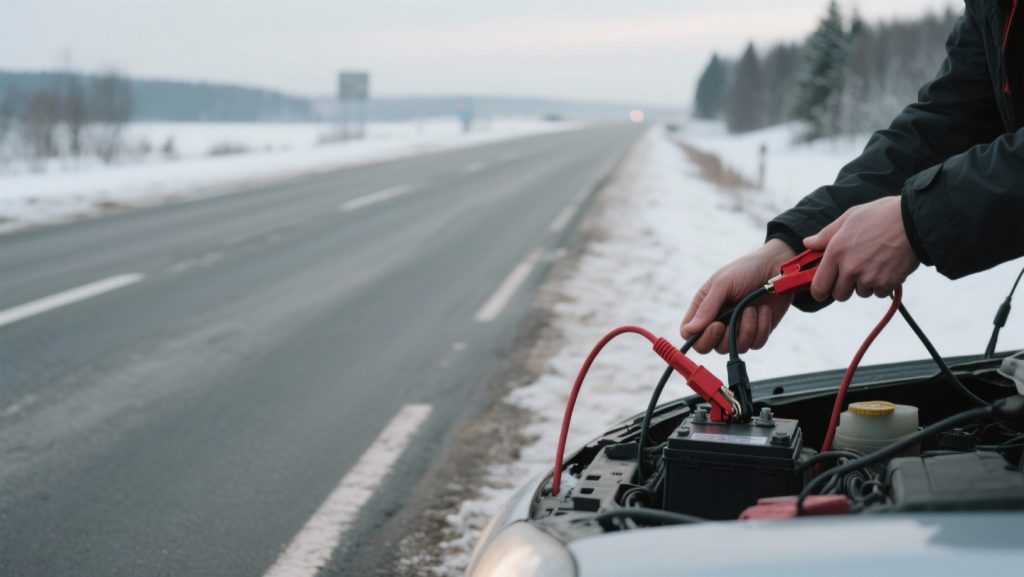
Proper preparation of your car is crucial for a worry-free journey. This certainly applies to the battery and jump leads. Preventing breakdowns in extreme temperatures is simpler than you might think. Whether you’re driving into the winter cold of Scandinavia or through the summer heat of Southern Europe, your battery’s condition determines whether you’ll start your car. A few simple checks and the right equipment make all the difference between arriving relaxed at your destination and waiting for help at the side of the road.
\n\nThe influence of heat and cold on your car battery
\n\n\n\nThe performance of a car battery is highly dependent on the ambient temperature. Extreme cold and heat have a direct negative impact on the chemical processes within the battery, causing its capacity and starting power to decrease. This is why most battery problems occur precisely during holidays in summer or winter.
\n\n\n\nStarting problems due to cold
\n\n\n\nAt sub-zero temperatures, the engine oil thickens, requiring the starter motor to use more energy to get everything moving. Simultaneously, the battery’s capacity decreases; the chemical reaction that supplies power slows down in the cold. As a result, a battery can lose up to 40% of its power in freezing conditions. If you’re driving to a winter destination like the Alps, a battery that worked perfectly fine in the Netherlands may suddenly be too weak to start the engine. Short trips, for example from your holiday cottage to the ski slope, are extra strenuous because the battery doesn’t get a chance to fully recharge.
\n\n\n\nOverloading due to heat
\n\n\n\nLess well-known is that heat is also a major enemy of the car battery. High temperatures under the bonnet, especially during long drives or in traffic jams on the way to Spain or Italy, accelerate self-discharge. Furthermore, systems like air conditioning run at full throttle, continuously putting a heavy strain on the battery and alternator. When you switch off the engine after a long, hot drive, the battery may not have enough power left to restart.
\n\n\n\n\n‘ If the voltage drops below 10 volts during starting, the battery needs to be replaced. ’
\n
How to test and maintain your car battery before departure?
\n\n\n\nAn annual battery check is a sensible habit, especially before a long driving holiday. You can assess the battery’s condition partially yourself, but for a reliable measurement, a visit to a garage is recommended.
\n\n\n\nChecking the battery yourself
\n\n\n\nA visual inspection is the first step. Check that the battery terminals are clean and free from white, powdery corrosion. This build-up hinders electrical conductivity. Clean the terminals and clamps with a wire brush and some warm water if necessary. Also, ensure the battery clamps are securely fastened. For older, non-maintenance-free batteries, check the fluid level and top up with demineralised water if required.
\n\n\n\nMeasuring the voltage
\n\n\n\nYou can measure the battery’s voltage with a simple multimeter. A healthy, fully charged battery in a resting state (with the engine off) should have a voltage of approximately 12.6 to 12.8 volts. A reading below 12.4 volts indicates a weak charge. If the voltage drops below 10 volts during starting, the battery is likely due for replacement. A garage will perform a more advanced test that measures the starting capacity under load. This test provides a much more reliable picture of the battery’s condition.
\n\nJump leads and other roadside assistance tools
\n\n\n\nShould you find yourself with a flat battery despite good preparation, roadside assistance tools are indispensable. Especially in remote areas or abroad, it’s reassuring to be able to help yourself.
\n\n\n\nChoosing the right jump leads
\n\n\n\nA set of jump leads is standard equipment for any driving holiday. When purchasing, pay attention to the thickness of the copper core, expressed in square millimetres (mm²). For most passenger cars, a cable of 25 mm² to 35 mm² is sufficient. The cables should be long enough and equipped with sturdy, fully insulated clamps. Cheaper, thin cables can overheat and do not provide sufficient current transfer to start an engine.
\n\n\n\nAlternatives: the jump starter
\n\n\n\nA modern and user-friendly alternative to jump leads is a jump starter. This is a compact, portable battery that allows you to start your car independently, without the help of another vehicle. For travellers heading to remote areas, such as the Norwegian fjords or the Scottish Highlands, a jump starter offers extra peace of mind. However, ensure the jump starter itself is fully charged before departure.
\n\nWhat to do with a flat battery on the road?
\n\n\n\nImagine you’re in a car park in the Alps and your car won’t start. With a set of jump leads and a helpful fellow traveller, you’ll be back on the road. Correctly using jump leads is important to prevent damage to the electronics of both cars.
\n\n\n\nStep-by-step guide for jump starting
\n\n\n\nFollow these steps carefully for a safe procedure:
\n\n\n\n- \n
- Switch off both cars and remove the keys from the ignition. \n\n\n\n
- Connect the red cable to the positive terminal (+) of the flat battery. \n\n\n\n
- Connect the other end of the red cable to the positive terminal (+) of the helping battery. \n\n\n\n
- Connect the black cable to the negative terminal (-) of the helping battery. \n\n\n\n
- Connect the other end of the black cable to an unpainted metal part of the engine or chassis of the car with the flat battery. This acts as an earth point and prevents sparks at the battery. \n\n\n\n
- Start the engine of the helping car and let it run for a few minutes. \n\n\n\n
- Now start the car with the flat battery. Once it’s running, let both engines run for another few minutes. \n\n\n\n
- Remove the cables in reverse order: first the black cable from the assisted car, then the black from the helping car, followed by the red cables. \n
After a jump start, drive for at least half an hour over a longer distance to give the battery a chance to recharge.
\n\n\n\nGood preparation is half the battle, especially for a driving holiday. On the Traveler Tips website, you’ll find many more practical guides and checklists for your trip, from planning the perfect road trip to choosing the right equipment. Discover more and set off without a worry.
\n\nFrequently asked questions
\n\n\nOptimal preparation of a car battery for a road trip through areas with extreme temperatures includes an annual voltage check and cleaning of the terminals. Use a trickle charger if parking for extended periods and switch off power-hungry accessories such as air conditioning and radio before starting. Drive regularly for at least 20 minutes to charge the battery and bring spare equipment such as jump leads or a jump starter. Adapt your strategy to the conditions: park in the shade in hot weather and in a garage in cold weather.
\n\nFor unexpected situations in extreme weather conditions, good, flexible jump leads with a thick copper core are essential. For passenger cars, a thickness of 25-35 mm² is recommended, while for heavier vehicles, 50-95 mm² is needed. Ensure the cables have insulated clamps that remain flexible, even at temperatures down to -20°C. This guarantees a reliable start and prevents damage to electronics.
\n\nSignals of potential problems in high or low temperatures include reduced battery starting capacity, especially in cold weather, and overheating under the bonnet in hot weather. At low temperatures, the battery can lose up to 40% of its power, putting extra strain on the starter motor. In high temperatures, accessories like air conditioning and electronics cause additional drainage, leading to insufficient power delivery and starting problems. Short journeys and stop-start systems discharge the battery faster, exacerbating problems in extreme temperatures. Annual battery checks and avoiding deep discharges can prevent issues.
\n\nTo prevent battery breakdowns when parking for extended periods in direct sunlight or severe frost, it is advisable to park the car in a garage or sheltered spot. For longer periods of inactivity, consider using a trickle charger to prevent deep discharge. During heatwaves, you can switch off the engine when stationary for a long time, remove the key from the ignition, and cover the windscreen from the sun. This helps to relieve the battery and regulate the temperature under the bonnet.
\n\n