 NL
NL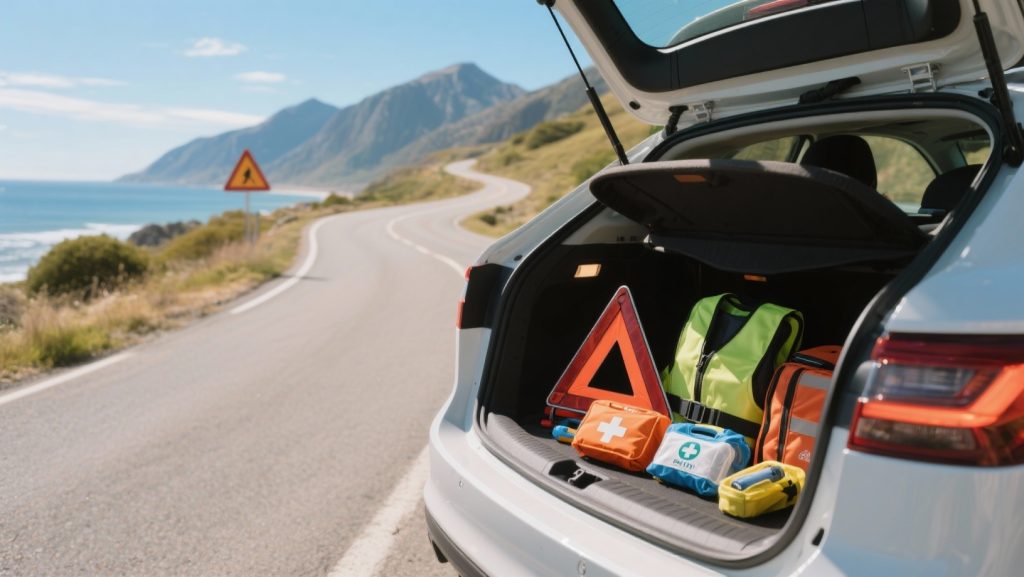
A complete emergency kit in your car, including a jack, tow rope, and first aid kit, forms the basis for a worry-free and safe road trip. Good preparation allows you to act independently and appropriately in the event of a breakdown or minor accident, without relying on assistance on a remote road. But do you also know which items are mandatory in popular holiday destinations and how to use them correctly when it matters?
\n\nWhy good preparation makes all the difference
\n \nA car holiday or road trip offers the greatest freedom. You set your own pace, choose your own route, and stop wherever you like. However, this freedom also brings with it a certain responsibility. Being stranded in the middle of the night with a flat tyre on a dark road, or being unable to treat a minor injury, can quickly turn your trip into an unpleasant experience. A carefully assembled emergency kit is your insurance against inconvenience and ensures you are prepared for the most common problems on the road. Fulfilling legal obligations is important, but your own safety and that of your fellow travellers come first.
\n‘ A well-stocked first aid kit helps you provide immediate first aid and prevent infections. ’
\n\nThe first aid kit: beyond the basics
\n \nAccidents can happen at any time, especially when travelling with children. A graze after playing or a cut during a picnic can occur quickly. A well-stocked first aid kit helps you to provide immediate first aid and prevent infections. Although a first aid kit is not legally mandatory in a passenger car in the Netherlands, it is required in many other European countries. In countries such as Austria, Switzerland, the Czech Republic, and Slovakia, you are obliged to carry a first aid box. This obligation is not dependent on travelling with children, but it is naturally felt even more necessary in such cases.
\n\n\n\nEnsure your first aid kit contains the following basic items:
\n\n\n\n- \n \n
- Plasters in various sizes \n\n \n
- Bandages and gauze swabs \n\n \n
- Disinfectant for cleaning wounds \n\n \n
- Scissors and tweezers \n\n \n
- Disposable gloves \n\n \n
- A survival blanket to protect someone from cold or heat \n\n
Before departure, check the expiry date of sterile products and supplement the kit with personal medication and, for example, a tick remover. Store the kit in a logical and easily accessible place, such as under the passenger seat, and not buried under luggage.
\nThe jack and wheel wrench: your saviour for a flat tyre
\n \nA flat tyre is one of the most common types of car breakdown. Knowing how to change a tyre gives you the independence to get back on the road quickly. The jack and wheel wrench are your most important tools for this. Although many modern cars are equipped with a tyre repair kit instead of a spare wheel, a jack is still essential if you do have a spare wheel. In some countries, such as Germany, a jack is even mandatory if your car does not have run-flat tyres.
\n\n\n\nChanging a tyre by the side of the motorway requires a cautious and safe approach. Follow these steps carefully:
\n\n\n\n- \n \n
- Pull the car as far onto the hard shoulder as possible and turn the wheels away from traffic. \n\n \n
- Switch on the hazard lights and put on a high-visibility vest before getting out. \n\n \n
- Place the warning triangle approximately 100 metres behind the car. \n\n \n
- Ensure the car is on a flat and stable surface. Never use the jack on a slope or soft verge. \n\n \n
- Loosen the wheel nuts slightly before jacking up the car. \n\n \n
- Place the jack on the designated jacking point, which you can find in your car’s manual. \n\n \n
- Jack up the car until the wheel is clear of the ground and change the tyre. \n\n \n
- Tighten the nuts by hand, lower the car, then tighten the nuts firmly with the wheel wrench. \n\n
Practise changing a tyre once at home in a safe environment. This way, you’ll know exactly what to do if you encounter a breakdown on the road.
\n\nJump leads and tow ropes: assistance with technical problems
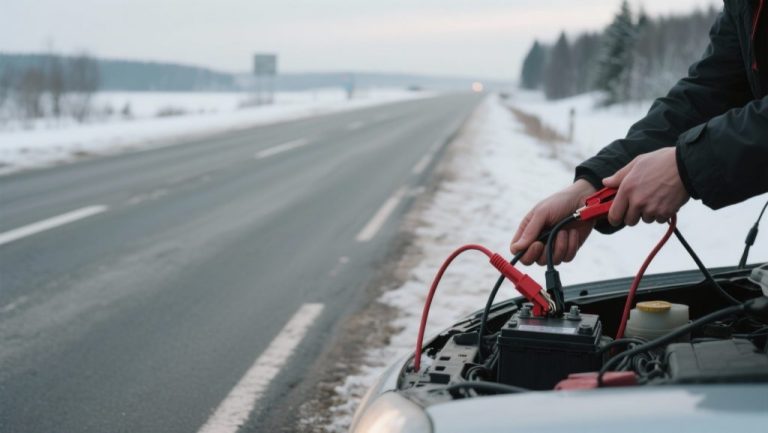
\n \nA flat battery is another common problem, for example, if you accidentally left the lights on. With a set of jump leads and the help of another motorist, you can often quickly resume your journey. Ensure the cables are suitable for your car’s power output. A tow rope is useful in situations where your car can no longer start and needs to be moved to a safe location.
\n\n\n\nWhen using jump leads, pay close attention to the correct connection order to prevent damage to the car’s electronics. Consult your car’s manual for specific instructions. Only use a tow rope for short distances and at low speeds. Communication between both drivers is crucial.
\n‘ Good preparation is an investment in a relaxed and safe journey. ’
\n\nAdditional equipment for travelling abroad
\n \nIn addition to the jack, tow rope, and first aid kit, there are other items that are mandatory in many European countries. Good preparation prevents fines and unsafe situations. Always check the specific rules of the countries you are travelling through before departure. The following items are often mandatory or highly recommended:
\n\n\n\n- \n \n
- High-visibility vests: In most European countries, it is mandatory to have a reflective high-visibility vest in the car for each occupant. These must be kept within easy reach. \n\n \n
- Warning triangle: Mandatory almost everywhere in Europe. In some countries, such as Spain, you must even carry two. \n\n \n
- Fire extinguisher: Mandatory in Belgium, Poland, and Greece, among others. Ensure the extinguisher is approved and within easy reach. \n\n \n
- Emergency hammer: Although not often mandatory, an emergency hammer is a small and affordable tool with which you can smash a window in an emergency. \n\n \n
- Torch: Indispensable for breakdowns in the dark. A headlamp is even more convenient, as it leaves your hands free. \n\n
Good preparation is an investment in a relaxed and safe journey. By being aware of the risks and bringing the right equipment, you can set off with peace of mind. On the Traveler Tips website, you will find much more practical information for planning your ideal car holiday, from the most beautiful routes to the latest traffic regulations per country. Discover our extensive information and travel smarter and with more experience.
\nFrequently asked questions
\nIn the Netherlands, a warning triangle and high-visibility vests are legally mandatory, but a first aid kit, jack, or tow rope are not. Stricter rules apply for travel abroad: a first aid kit is mandatory in countries such as Austria, Switzerland, the Czech Republic, and Slovakia. A jack may be mandatory in some EU countries if there is no spare wheel. A tow rope is not legally mandatory but is recommended for emergencies, as is a survival blanket.
\n\nFor a worry-free road trip, even if it’s not mandatory, a jack, tow rope, and first aid kit are highly recommended. A survival blanket, duct tape for quick repairs, and work gloves are also useful. Furthermore, don’t forget to take a European Accident Statement form with you and have your travel insurance number ready.
\n\nWhen choosing a reliable first aid kit, look for sterile plasters, bandages, disinfectant, and a survival blanket; check expiry dates and supplement with gloves. For a jack, it is crucial that it is suitable for your car and that you know how to use it safely on a flat surface, possibly with work gloves. Choose a tow rope with sufficient amperage that matches your car and learn the correct jump-start sequence for safe use with a flat battery. Remember that these items are not legally mandatory in the Netherlands, but they are in many European countries, so always check the specific requirements of your travel destination and test the jack beforehand.
\n\nConsult your car’s manual for the correct placement points and instructions for using emergency equipment. Only use a jack on a flat surface and raise the car to the correct height for a tyre change. When using jump leads, follow the instructions for the starting sequence, such as switching off the engine before connecting the leads. A first aid kit is essential to prevent infections and provide first aid for injuries or accidents.
\n\nThe most practical and accessible way to store emergency equipment in the car is to keep it in the boot as standard. Ensure items such as the first aid kit, warning triangle, and tow rope are easy to reach when needed. This minimises search time in an emergency and keeps the passenger compartment clear. Ford and Opel manuals also recommend this method for optimal safety and ease of use.
\n\nCheck the first aid kit for expiry dates and replenish it with necessary items such as plasters, disinfectant, and a survival blanket. Test the jack beforehand to ensure it functions correctly and know where the jacking points are in your car. Ensure the tow rope has sufficient amperage for your car and that you know how to use it safely. Store all emergency equipment in an easily accessible place, ideally in the boot.
\n\n