NL
NL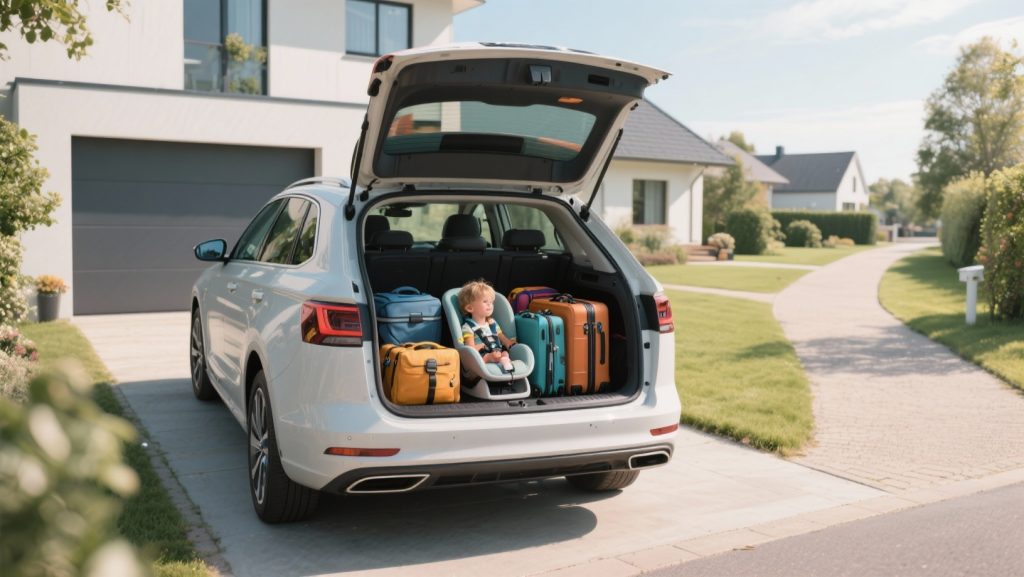
An approved child seat and a correctly packed car are not minor details, but the foundation of a safe journey. The topic of child seats and luggage: rules and safe car packing is therefore a core component of well-considered travel planning. Read on and discover how, with a few targeted steps, you can significantly improve the safety and comfort for all your passengers.
\n\nThe right child seats: rules in Europe
\n\n\n\nWithin the European Union, the use of an approved child seat is mandatory for children up to a certain height or age. The basic rule is that every child under 1.35 metres must sit in a suitable and approved car seat. When purchasing or using a seat, pay attention to the approval marks. This must be an ECE R44/04 or an R129 (i-Size) approval mark. The i-Size standard is newer and sets stricter requirements, such as mandatory rearward facing travel for at least 15 months and better protection in a side-impact collision.
\n\n\n\nThe safest place for a child seat is always in the back seat. Never place a child seat in the front passenger seat if the airbag is activated. In a collision, the force of the airbag can cause serious injury. If the airbag cannot be deactivated, the back seat is the only correct option. For the very youngest children (up to 15 months), rearward-facing travel is the norm, as this better protects the neck and head in a frontal collision.
\n\n\n\nSpecific rules in popular holiday destinations
\n\n\n\nAlthough the basic rules in the EU are harmonised, details may vary by country. In Germany, as in the Netherlands, a child seat is mandatory for children up to 1.50 metres or 12 years old. The German police and the inspection body (TÜV) are known for their strict controls on the correct fastening and use of approved seats. In countries like France and Belgium, fines for incorrectly transporting a child can be substantial. Therefore, always check the specific rules for your destination and any transit countries before departure.
\n\n\n\n\n‘ A water bottle, book, or tablet turns into a dangerous projectile during sudden braking. ’
\n
Safely packing your car for a family road trip
\n\n\n\nA well-packed car is a stable car. The vehicle’s centre of gravity plays an important role here. The lower the centre of gravity, the better the road holding. The basic principle is therefore simple: place the heaviest luggage as low and as close to the rear axle as possible. This means at the bottom of the boot and as close as possible to the backrest of the rear seats. This makes the car more stable and reduces the chance of luggage shooting through the car during an emergency stop.
\n\n\n\nFollow a logical order when loading. A good approach looks like this:
\n\n\n\n- \n
- Heavy items first: Place suitcases, crates of drinks, or a cool box directly on the boot floor, against the back seats. \n\n\n\n
- Lighter items on top: Place lighter and softer luggage such as bags of clothes, sleeping bags, or towels on top of the heavy items. \n\n\n\n
- Keep the parcel shelf clear: Never place loose items on the parcel shelf. A water bottle, book, or tablet turns into a dangerous projectile during sudden braking. \n\n\n\n
- Use a luggage net: If you stack luggage higher than the backrest of the rear seats, use a luggage net or cargo barrier. This prevents items from coming forward in a collision. \n
Also check your car’s maximum permissible weight. This is stated on the vehicle registration document. An overloaded car has a longer braking distance, handles differently in bends, and consumes more fuel.
\n\nProperly using a roof box
\n\n\n\nA roof box offers extra storage space, but it is not intended for heavy items. The weight on the roof increases the car’s centre of gravity, which negatively affects road holding. Therefore, only use a roof box for light, bulky items such as sleeping bags, tents, or beach gear. The maximum weight for a roof box is usually between 50 and 75 kilograms. Always check what the car manufacturer and roof box manufacturer prescribe.
\n\n\n\nDistribute the weight in the roof box evenly. The rule of thumb is to place about 50% of the weight in the middle, between the roof bars. The remaining 50% should be distributed evenly over the front and back. Ensure all items in the box are securely fastened with the supplied straps so they don’t shift during the journey.
\n\nInfluence of luggage on tyre pressure before departure
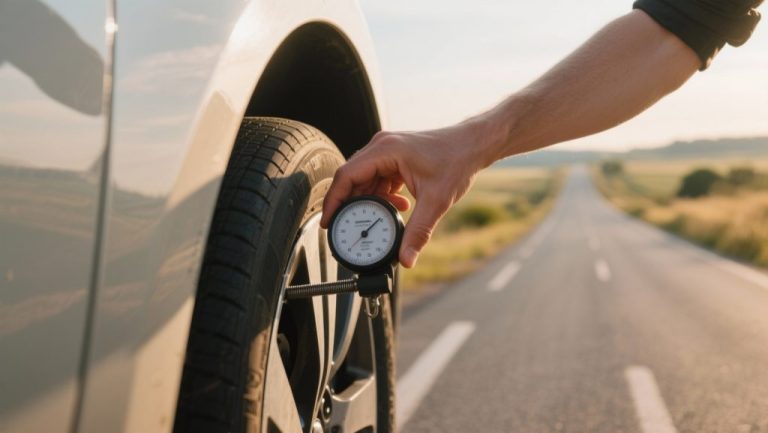
\n\n\n\nExtra weight from passengers and luggage directly affects the tyres. A fully loaded car requires higher tyre pressure than for daily use. Correct tyre pressure ensures stable road holding, a shorter braking distance, and prevents excessive tyre wear. Driving with insufficient tyre pressure can lead to overheating and even a blow-out.
\n\n\n\nThe recommended tyre pressure for a loaded car is usually stated on a sticker inside the driver’s door, in the fuel cap, or in the car’s instruction manual. This value is often 0.3 to 0.5 bar higher than the normal pressure. Check the tyre pressure when the tyres are ‘cold’, i.e., before you have driven a long distance. Preferably do this after the car has been fully packed, so the measurement corresponds to the actual travel weight.
\n\n\n\nOn the Traveler Tips website, you’ll find much more useful information about route planning, vignettes for European countries, and the most beautiful destinations for your next driving holiday. Discover more and set off perfectly prepared.
\n\nFrequently asked questions
\n\n\nIn European countries, child seats must be placed in the back seat, unless there are no active airbags in the front passenger seat. They must comply with the ECE R44/04 or i-Size standard and be rearward-facing until 15 months for better neck protection. When travelling across borders, it’s important to know that there may be regional variations in fines and specific requirements, such as mandatory i-Size in Spain and Italy from 2013. Always check the type plate on the seat for approval and test the firmness of the installation. It is advisable to check the specific rules of the destination country, for example, via the ANWB.
\n\nTo pack the car safely and efficiently for a comfortable journey, place heavy items at the bottom of the boot, as close as possible to the back seat, to lower the centre of gravity and improve road holding. Place light and bulky items on top of these, and ensure there are never loose items on the back seat or parcel shelf to prevent them from becoming projectiles in an emergency stop. Use a luggage net if the luggage extends above the backrest and only fill a roof box with light items, centred on the roof for stability and weight distribution. Finally, adjust the tyre pressure for the extra weight.
\n\nInformation regarding luggage, roof boxes, and bike racks in popular holiday destinations outlines specific guidelines. For example, roof boxes should only be filled with light items, with a maximum weight stated on the box itself (often 50-75 kg), and heavy items must be placed at the bottom of the boot. For Austria, a maximum roof load of 75 kg applies. Furthermore, it is essential not to exceed the total permissible mass and to adjust tyre pressure for any extra weight.
\n\nPlace heavy items at the bottom of the boot, close to the back seat, to keep the car’s centre of gravity low. Light, bulky items can go on top, but avoid loose items on the back seat or parcel shelf, as these can become dangerous projectiles during an emergency stop. Use a luggage net to secure luggage extending above the backrest and consider a boot organiser for small, important items. Adjust the tyre pressure for the extra weight to ensure optimal safety and road holding.
\n\nTo check if your child seat is correctly installed and meets safety standards, always place it in the back seat and use an approved seat (ECE R44/04 or i-Size standard). Test its firmness; the seat should not wobble more than 2-3 cm when secured with the car seat belt or ISOFIX. Check the regional regulations of your travel destination, for example, via the ANWB Roadside Assistance app, as fines and standards can vary. Do a practice session before departure to see how luggage fits around it and for optimal balance.
\n\n