 NL
NL
A well-thought-out approach to safely distributing weight and luggage in the car prevents dangerous situations and ensures stable road holding. It’s a preparation you don’t want to skip. Read on and discover how a few logical steps can limit risks and enhance driving comfort.
\n\nWhy correct weight distribution is important
\n \nA car fully loaded for a holiday reacts differently than you are used to. The extra weight affects acceleration, braking distance, and stability in bends. Incorrect luggage distribution negatively reinforces these effects. Placing heavy items incorrectly raises the car’s centre of gravity, which can lead to swaying or even loss of control during a sudden evasive manoeuvre. Correct distribution ensures a low centre of gravity and a balanced equilibrium, keeping the car predictable and controllable.
\n\n\n\n‘ Exceeding this weight is not only punishable, but also endangers safety. ’
\n
Check your car’s maximum load capacity
\n \nEvery car has a maximum permissible total weight. This is the weight of the car itself, plus all passengers and luggage. Exceeding this weight is not only punishable, but also endangers safety. The brakes and suspension are not designed for an excessive load, which can lead to technical malfunctions. You can find the maximum total weight and permitted axle loads in your car’s instruction manual or on its registration certificate. Weigh your luggage before you depart to stay within the limits.
\n
Smart and safe boot packing
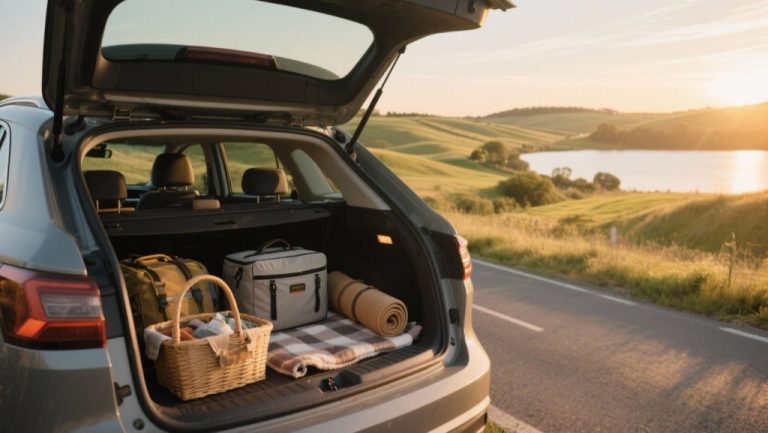
\n \nThe boot is the designated place for the heaviest luggage. Good organisation is crucial for the car’s stability. Follow these guidelines for safe and efficient packing:
\n\n \n- \n \n
- Heaviest items at the bottom and against the back seat: Place suitcases, bags with heavy contents, and other heavy objects directly on the floor and as close as possible to the backrest of the rear seat. This keeps the centre of gravity low and central, and prevents the load from shifting forwards during an emergency stop. \n\n \n
- Distribute weight evenly: Ensure a good balance between the left and right sides of the car. Uneven distribution can negatively affect handling in bends. \n\n \n
- Fill empty spaces: Use soft items, such as sleeping bags, towels, or jackets, to fill the gaps between larger luggage items. This prevents the luggage from shifting. \n\n \n
- Work from large to small: Start with the largest and heaviest items and fill the remaining space with smaller, lighter bags. Items you need on the go, such as a first-aid kit or a coat, place on top for easy access. \n\n \n
- Use a luggage net: If you stack luggage higher than the backrest of the rear seat, always use a partition net or rack. This prevents loose items from flying into the passenger compartment during harsh braking. Remove the parcel shelf or, in any case, do not place loose objects on it. \n\n
Tips for the roof box
\n\n \nA roof box is an excellent solution for extra storage space, but it is exclusively intended for light and bulky luggage. The weight on the roof greatly influences the car’s stability. Therefore, consider the following points:
\n\n \n- \n \n
- Light items only: Use the roof box for items such as clothes, sleeping bags, tents, or skis. Heavy items belong in the boot. \n\n \n
- Even distribution inside the box: Distribute the weight evenly within the roof box. A good rule of thumb is to place approximately 50% of the weight in the middle (between the roof bars), with 25% at the front and 25% at the back. \n\n \n
- Check the maximum roof load: Every car has a maximum roof load, which you can find in the manual. This is the total weight of the roof bars plus the roof box and its contents. Never exceed this limit. \n\n \n
- Be aware of the height: Be aware of your car’s extra height. This is especially important in car parks, tunnels, and underpasses. \n\n
The final check before departure
\n \nOnce everything is loaded, it’s wise to perform one last check. A heavily loaded car requires adjusted tyre pressure. The correct pressure for a loaded vehicle is often indicated on a sticker in the door frame or on the inside of the fuel cap. Correct tyre pressure ensures better road holding and prevents excessive wear. Consider taking a short test drive nearby to get used to the car’s altered handling.
\n\n\n \nA well-prepared journey begins with smart packing. By paying attention to weight distribution, you increase safety for yourself and your passengers while also ensuring a more comfortable ride. On the Traveler Tips website, you’ll find more practical articles about preparing for your car holiday, from the best routes to mandatory equipment abroad. Discover how to travel smarter and better prepared.
\n\n\nFrequently asked questions
\nAn incorrectly distributed load raises the car’s centre of gravity, adversely affecting road holding and stability. This leads to a greater chance of swaying, body roll in bends, and unexpected reactions during emergency stops. Risks include reduced vehicle control, a longer braking distance, and the possibility of loose objects becoming projectiles in a collision. Careful weight distribution and checking the maximum load are crucial for a safe journey.
\n\nThe most efficient method to pack luggage in your car, considering weight distribution and accessibility, is to place heavy items at the bottom and centrally against the back seat. Distribute the weight evenly left-to-right and fill gaps with soft items. Use a luggage net or divider to prevent shifting, and place frequently used items on top for easy access. Roof boxes are ideal for light, bulky items, evenly distributed and centrally mounted.
\n\nFor a safe car journey, it is crucial to correctly distribute weight and luggage, placing heavy items low and centrally in the boot. Always check the maximum roof and total load via the vehicle manual or registration certificate to prevent overloading. Place light, bulky items in the roof box and distribute the weight evenly. Weigh your luggage, check tyre pressure, and test the load on a short drive before departure to avoid fines and accidents.
\n\nFor the safe transport of large or unusual items, correct weight distribution is crucial. Place heavy items low and centrally in the boot, directly against the back seat, and distribute the weight evenly. Use a luggage net to prevent shifting and reserve the roof box for light, bulky items, evenly distributed along its length. Always check your vehicle’s maximum load and adjust tyre pressure for extra cargo.
\n\nTo ensure safe and organised weight distribution in the car, various tools and accessories are available. A luggage net or divider can help keep luggage secure, especially with high stacks. For roof boxes and roof bars, it’s important to only transport light, bulky items and distribute them evenly. Weighing luggage and checking tyre pressure are also crucial steps. Soft bags are often more efficient than hard cases for compact packing.
\n\n