NL
NL
Proper preparation for toll roads and vignettes in Europe is a smart move that saves you unexpected costs and delays. The rules vary greatly from country to country, and it’s easy to lose track amidst the numerous vignette and toll gate systems. Do you know exactly how to make the right choices for your upcoming road trip? Read on and discover how to travel smoothly and prepared through Europe.
Vignette Systems: Austria and Switzerland
In several popular holiday countries, you need a vignette to drive on motorways. This is proof that you have paid for using the road network for a certain period. Austria and Switzerland are the best-known examples where a vignette is mandatory.
How do I buy a vignette for Austrian motorways?
For Austrian motorways, known as ‘Autobahnen’, a vignette is mandatory for all vehicles up to 3,500 kg. You have a choice of two types: the classic sticker you attach to your windscreen or a digital vignette linked to your number plate. Both variants are equally valid. The digital version is often more practical, as you don’t have to stick or remove it.
You can purchase the vignette via:
- Online: The easiest way is via the official webshop or app of the Austrian motorway operator ASFINAG. Please note that a vignette purchased online for consumers is only valid 18 days after purchase. This is due to the European right of withdrawal.
- On the road: You can also buy the vignette at petrol stations and service stations in border regions, both in Germany and in Austria itself. These vignettes are valid immediately.
Multiple validity periods are available, such as 10 days, 2 months, or a full year. Choose the option that best suits your travel plans.
The vignette for Switzerland
The system in Switzerland is simpler than in Austria. There is only one type of vignette available, which is an annual vignette. This vignette is valid from 1 December of the previous year until 31 January of the following year, making it valid for a total of 14 months. Whether you are passing through for a day or staying for a whole month, you always pay the same price. As in Austria, you can choose between a sticker or a digital vignette linked to your number plate. You can buy the vignette online via the official Swiss government website or physically at the border, petrol stations, and post offices.
‘ Planning your route is more than just finding the quickest way from A to B. ’
Toll Gates in Southern Europe
In countries like France, Spain, and Italy, you don’t pay a fixed amount for a period, but rather for the kilometres you actually travel on the motorway. This usually happens via toll gates.
What are the toll roads in France and how do I pay them?
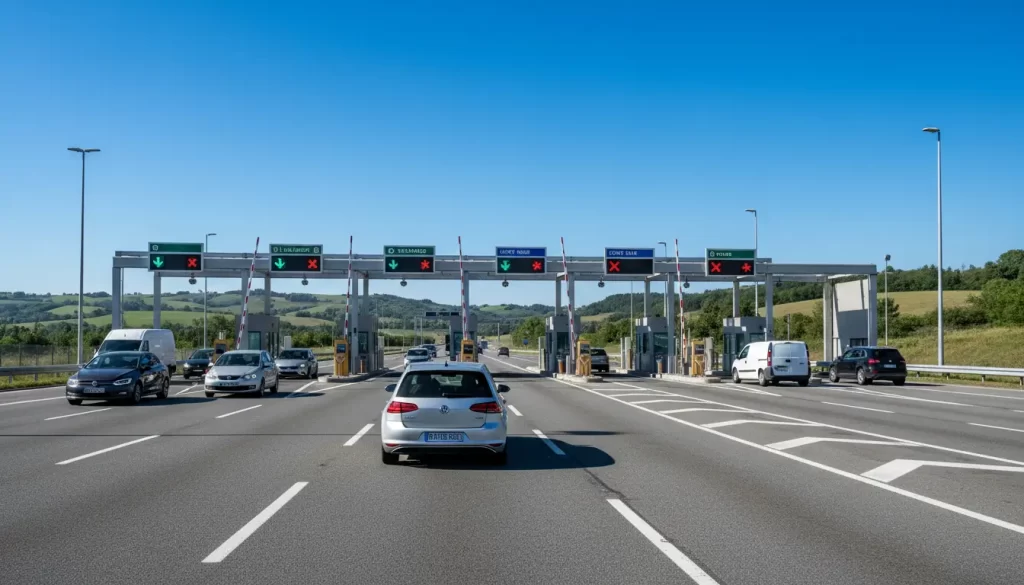
Private companies largely manage French motorways, the ‘autoroutes’. Here, you pay a toll, also called ‘péage’. When entering a toll road, you usually take a ticket from a machine. When you exit the toll road, you insert this ticket at a payment station and settle the distance travelled. Payment can be made via:
- Cash (pièces et billets): These lanes are becoming increasingly rare, but are sometimes still available.
- Credit card (CB or cartes): The fastest and most commonly used method. The payment machines accept almost all Dutch and Belgian credit cards.
- Toll badge (télépéage): An electronic badge that you stick behind the windscreen. With this, you drive through special gates without stopping. The system processes the payment automatically. This saves a lot of time, especially on busy travel days.
Are there toll alternatives for road trips to Spain?
Yes, absolutely. The Spanish road network consists of two types of main roads: the ‘autopistas’ (indicated with AP) and the ‘autovías’ (indicated with A). Autopistas are toll roads where you pay for their use, similar to the French system. Autovías, on the other hand, are free to use and offer an excellent alternative. They are often just as well maintained as the toll roads, but the route sometimes takes a little longer because they pass through more urban areas and have more on and off-ramps. With a route planner like Google Maps or Waze, you can easily select the ‘avoid tolls’ option to calculate an alternative route.
How do I avoid unexpected tolls in Italy with a caravan?
Italy uses a similar toll system to France. You pay per kilometre. Rates depend on the vehicle class, with a car and caravan falling into a higher class than a standalone car. This significantly increases costs. To avoid surprises, good route planning is important. Some Alpine tunnels, such as the Mont Blanc or Fréjus Tunnel, have very high toll charges. By planning your route in advance, you might consider driving via a mountain pass as an alternative. This takes more time, but is often more financially advantageous and often offers beautiful views. Check your planned route in a route planner that also indicates toll costs. This way, you’ll get a good idea of the expected expenses and can adjust the route if necessary.
Planning your route is more than just finding the quickest way from A to B. By consciously choosing toll roads, vignettes, or alternative routes, you maintain control over your travel time and budget. The right preparation ensures that you don’t encounter any unwanted surprises along the way.
Dreading the research involved with all these rules and routes? That’s exactly what Traveler Tips helps you with. Our carefully compiled route packages consider the most efficient and pleasant roads, including a clear overview of expected toll costs. This allows you to fully enjoy your trip, without worrying about the details. You’ll save time during preparation and are guaranteed a smooth journey. Start your trip relaxed and check out our route packages.
Frequently asked questions
Most Central and Eastern European countries, such as Austria, Bulgaria, Czech Republic, Hungary, Romania, Slovakia, Slovenia, and Switzerland, require vignettes. Average costs for an annual vignette range from approximately €18 in Hungary to €115 in Slovenia and €106.80 in Austria; for 10 days, costs are between €10 and €29.20. Countries like France, Italy, Spain, and Portugal have toll roads with gates where payment is made per kilometre or section, while Poland and Germany largely have free motorways, with the exception of some tunnels or bridges. Europe is shifting towards digital and kilometre-based toll systems, which may lead to price increases and higher fines for evasion.
Vignettes are best purchased online in advance via official apps or websites such as ASFINAG-shop or Edalnice.cz, where they are linked to your number plate. On site, vignettes are available at petrol stations near borders. For toll roads with gates in countries like France and Italy, payment can be made directly at the toll booth. Payment methods include cash, card, or via an app.
It is possible to consider toll-free routes as an alternative to toll roads, especially in countries with toll gates such as France, Italy, Spain, and Portugal. These alternative routes can be planned using navigation apps like Google Maps or ViaMichelin by selecting the ‘avoid tolls’ option. By choosing toll-free routes, you can save 20-50% on costs for long journeys, but you should factor in extra travel time, which depends on the distance and the specific route. Buying digital vignettes in advance for countries like Austria or the Czech Republic is a useful tip to avoid fines, even if you take toll roads.
Vignettes are mandatory, often digital passes for motorways in Central and Eastern European countries, while other countries such as France and Italy operate with toll roads and gates where payment is made per kilometre or section. Correct use involves purchasing a valid vignette in good time, either digital or as a sticker, linked to the vehicle’s number plate. Non-compliance is strictly monitored by cameras and can lead to significant fines, such as €120-€300 in Austria or €200 in Hungary. Generally, fines for toll evasion can amount to up to €270, depending on the country and the specific infringement.