 NL
NL
The choice between one-way and round trip driving routes determines the structure of your entire journey. A one-way route gives you maximum freedom to discover new areas without having to return, but car hire companies often charge extra for this. A round trip is usually more economical and easier to plan, but it does require more driving time. Which type of route is best suited to your next trip? Read on to discover the pros and cons of both options.
The one-way driving route: maximum flexibility
A one-way route, also called a single journey, means that you return the hire car at a different location from where you picked it up. This is an excellent choice for travellers who want to cover a long distance and do not want to drive back along the same road. You see more of a country or region because you are not tied to a fixed start and end point. Think of a trip along the coast or a route that cuts right through a country.
The benefits of a single journey
The biggest advantage of a one-way route is efficiency. You make optimal use of your time, because every kilometre brings you closer to a new destination. You do not need to allow days just to drive back to your starting point. This gives you the opportunity to travel further and see more. For example, you can make a logical journey from Brussels to Amsterdam, visiting cities such as Antwerp and Rotterdam on the way without taking a detour.
What you need to take into account
Car hire companies usually charge a ‘one-way fee’ or ‘drop-off charge’ for this flexibility. This surcharge covers the costs of returning the car to the original location. The amount varies greatly depending on the hire company, the country and the distance between the pick-up and drop-off points. Costs can range from a few dozen to several hundred euros. Always compare the terms and conditions of several providers.
‘ A round trip is more than just an out-and-back route. ’
The round trip: familiar and budget-friendly
A round trip is the classic driving holiday where you return the car at the place where you picked it up. Travellers often choose this type of driving holiday. It is not only financially attractive, but also provides a sense of structure. You plan a route in the shape of a loop, which still allows you to explore a varied area. A round trip certainly does not have to mean driving the same road there and back.
Saving money and planning with clarity
The main advantage of a round trip is that you avoid the extra drop-off charges. The money you save can be spent on other parts of your journey. In addition, booking flights is often clearer and cheaper if you fly in and out of the same airport. Planning the route also becomes more straightforward, as you are working towards a fixed end point that is also your starting point.
Creative routes in a round trip
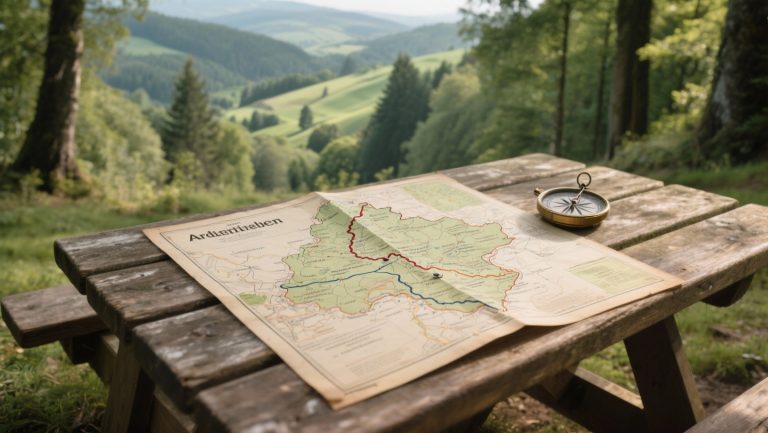
A round trip is more than just an out-and-back route. You can map out a circular route that takes in several highlights. Think of a loop around the Veluwe, where you start in Apeldoorn and return via various nature reserves and villages. Or a route around the Three-Country Point, where you make a loop from Maastricht through the Belgian Ardennes and the German Eifel. This way you combine the benefits of a round trip with a varied travel experience.
- Veluwe loop: Start in a city such as Arnhem or Apeldoorn and explore De Hoge Veluwe National Park, the Veluwezoom and the fringe lakes in a logical loop.
- Three-Country Point route: Begin in Maastricht and drive a circle via Liège in Belgium and Aachen in Germany. This way, you experience three cultures in one short, efficient route.


Which route suits your trip?
The choice between a one-way route and a round trip depends on your personal preferences, your budget and the time you have. Both options have clear advantages. Go through the following points to make the right decision for your next driving holiday.
- Budget: If you want to keep costs down, a round trip is almost always the cheapest option. The saving on the one-way fee can be substantial.
- Time: Short on time? Then a one-way route can be more efficient. You do not lose time on the return journey and can fully focus on discovering your route.
- Destination: For vast areas or long, linear routes, a one-way route is very suitable. To explore one specific region, a round trip is often a logical and practical choice.
- Travel style: Do you enjoy the freedom of constantly travelling onwards without looking back? Then a one-way route is for you. If you prefer clear structure and the convenience of a fixed start and end point, a round trip is a better fit.
Whether you opt for the freedom of a single journey or the benefits of a round trip, good preparation is the foundation of a successful driving holiday. On the Traveler Tips website you will find more articles on planning routes, ideas for your luggage and inspiration for the most beautiful destinations. Discover how to travel smarter and with more enjoyment.
Frequently asked questions
A one-way driving route often comes with a ‘one-way fee’, which can range from €200 to €500, and possibly higher insurance costs for unpaved roads. In contrast, with a round trip you avoid these drop-off charges, but you do need to take into account extra fuel costs and travel time for the return to the starting point. Although one-way routes offer flexibility and can shorten driving time, round trips are financially more advantageous because there are no extra costs for returning the car to a different location.
A one-way driving route offers more flexibility and depth, as you can experience a variety of landscapes and cities without having to drive back. It allows travellers to follow a linear route, avoiding repeated stretches and leaving more time for new discoveries. This leads to a more efficient use of travel time and the opportunity to visit unique highlights that might otherwise remain out of reach. Although there are often extra costs, the travel experience is enriched by the variety and the focus on new impressions.
A round trip route makes the best use of the available travel time and minimises unnecessarily long driving times when it is planned efficiently to avoid repetition and limit travel time. Although one-way routes can offer a shorter total driving time and less repetition, they often involve extra costs such as a ‘one-way fee’. Round trips avoid these costs, but require careful planning to keep driving time under control and visit parks or sights efficiently. The choice depends on budget, time and preference, with planning using tools such as Google Maps being crucial.
A round trip offers the most comfort and the simplest logistical planning for accommodation and transport. Although a one-way route is more flexible and avoids out-and-back driving, it often comes with extra costs, the so-called ‘one-way fee’. Round trips save these costs by returning to the starting location and are ideal for travellers who want less logistical hassle. For families or budget travellers, a round trip is therefore often the better choice.
A one-way driving route offers significantly more flexibility to change plans spontaneously or discover new places along the way, because there is no need to drive back to a starting point. This saves driving time and avoids repeating routes, allowing more focus on highlights. Although there is often a ‘one-way fee’ attached, the extra freedom is valued by travellers who want to explore linear routes. It allows travellers to start their route in one city and end in another, which is ideal for visiting national parks that are spread out along a line.