NL
NL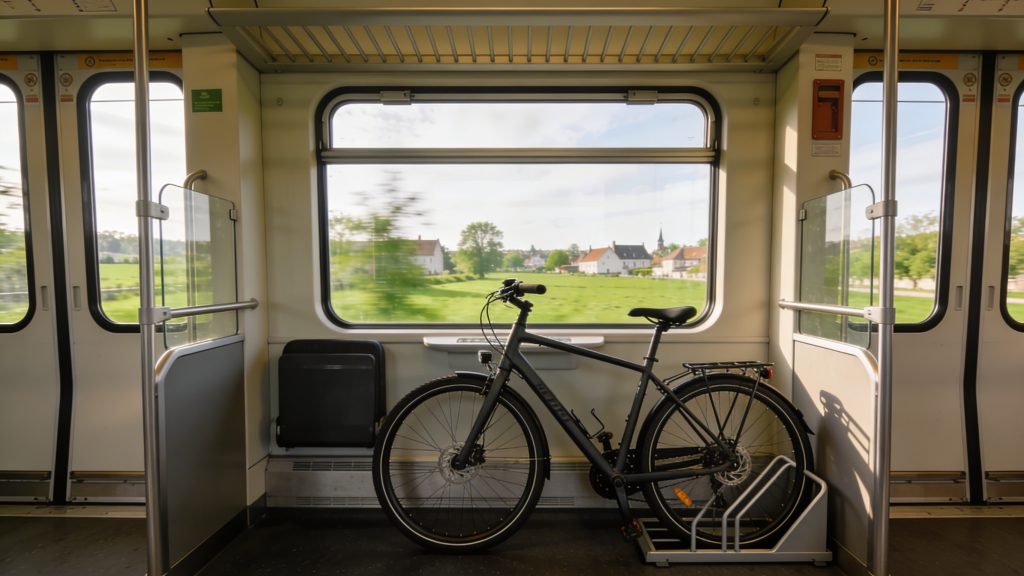
You are allowed to take your bike on all domestic Belgian trains, but you must always buy a compulsory bike ticket. The space for bicycles varies greatly per type of train: modern trains offer more spots, while older models have limited capacity. Speak to the train conductor so you can find the best place for your bike. Read on to find out exactly how to plan a smooth trip with your bike through Belgium.
Belgium is an attractive destination for cycling enthusiasts who want to travel by train. You might be planning a city break to Ghent and Antwerp, or choosing a train holiday with a bike through the Ardennes. In both cases, taking your bike on the train gives you flexibility and freedom. The Belgian railways offer this option for domestic routes, but you do need to take a few rules and practical points into account.
The main rule is simple. A bike is allowed on all domestic trains. For this you always need a separate bike ticket. The type of train determines how much space is available and how easy it is to place your bike. With the right preparation you avoid surprises and ensure a smooth start to your cycling holiday.
How much does a bike ticket cost in Belgium
To take your bike on a Belgian domestic train you pay a fixed fare. This bike ticket is compulsory, regardless of the distance you travel. You can buy the ticket at a ticket office, from a ticket machine or via the official app of the Belgian railways. Make sure you have the ticket with you before you board, as checks are carried out during the journey.
The fare is the same for all domestic routes. This means you pay the same for a short journey between two nearby cities as you do for a longer trip right across the country. This fixed price makes it easy to calculate your travel costs in advance. Always check the current price, as fares can change.
No reservation needed for domestic trains
For domestic intercity trains in Belgium you do not need to reserve a place for your bike. You simply board and look for a suitable spot. This gives you flexibility when planning your trip, but it also means you are not guaranteed a place during busy periods.
In practice, boarding with your bike works like this:
- Look for the bicycle symbol on the outside of the carriages
- Board a carriage that is marked for bicycles
- Speak to the train conductor to ask where you can best place your bike
- Make sure your bike is positioned securely and does not obstruct other passengers
Speaking to the train conductor is not compulsory, but it is a sensible choice. The conductor knows the train and which spaces are available. Especially on busy trains this can be the difference between a comfortable journey and wandering around looking for a suitable place.
Difference between old and new trains
The available bike space strongly depends on the type of train you are travelling on. Modern trainsets are equipped with special bicycle areas that offer more capacity and are easier to access. These spaces are clearly marked and equipped with hooks or standing areas where you can place your bike safely.
Older trains often have limited space for bicycles. These models usually have a small area near the doors or in a multifunctional zone that is also intended for pushchairs and wheelchairs. During rush hours it can get cramped here. Are you travelling on older trainsets? Then try to travel outside peak times if possible.
The advantages of modern trains:
- Greater capacity for several bikes at the same time
- Separate bicycle areas that are kept apart from the seating
- Better accessibility thanks to wider doors and a flatter step
- Clear markings and instructions for cyclists
Tips for a smooth trip with your bike
Good preparation ensures a relaxed journey. Plan your departure outside the morning and evening rush hours when trains are at their busiest. This gives you more space and helps avoid having to wait for a later train because there is no room left for your bike.
Check in advance which type of train runs on your route. Some travellers deliberately choose routes with more modern trains. This may mean a longer journey time. The official app and website of the Belgian railways provide information about the rolling stock that is being used.
Take transfers into account. Does your route involve several changes of train? Then you will have to find a suitable place again on each train. Allow enough transfer time, especially at major stations where you may have to walk some distance between platforms. With a bike you need more time than when travelling without luggage.
‘ High-speed trains such as the Thalys between Brussels and Paris do not allow regular bicycles. ’
When bike transport is restricted or prohibited
In principle, domestic trains always allow bicycles. However, there are situations where this works less well in practice. During extremely busy times, such as major events or public holidays, the train conductor may decide to stop accepting additional bikes on an already full train. In that case you have no choice but to wait for the next train.
Different rules apply to international routes. High-speed trains such as the Thalys between Brussels and Paris do not allow regular bicycles. Some cross-border services also have restrictions or require a reservation in advance. Are you travelling with your bike to or from Belgium via another country? Then always check the rules of all the rail companies involved beforehand.
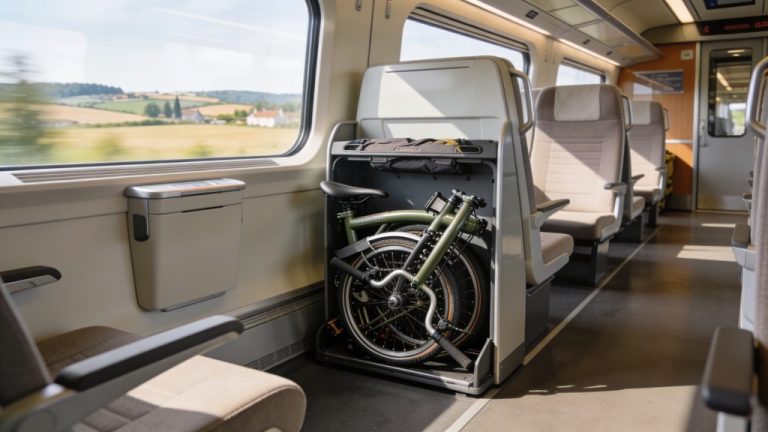
A folding bike offers more flexibility. If it is fully folded and packed in a bag or cover, it is often treated as hand luggage. This means you do not need a separate bike ticket and in principle you may use all trains, including international services where regular bicycles are not permitted.
Alternative options for cyclists
In addition to taking your own bike, there are alternatives that can simplify your trip. In many Belgian cities you can rent bicycles via local rental services or bike-sharing schemes. This saves you the hassle of boarding and alighting with your own bike, while still giving you the freedom to continue your journey by bike once you arrive.
You can also send your bike ahead to your final destination. Some specialised services offer this, especially for longer holidays. You then travel comfortably by train yourself, and your bike is waiting for you at your destination. This is particularly useful if you have to make several transfers or if you are travelling on older trains where space for bikes is limited.
Practical points to consider during the journey
During the journey you are responsible for your own bike. Make sure it is standing firmly and cannot fall over when the train brakes or jolts. Some trains have brackets or hooks for securing the front wheel. Use these facilities if they are available.
Keep an eye on your bike, especially at busy stations where many passengers are boarding and alighting. It is best to attach your luggage to your bike or keep it close to you. Always take valuables with you to your seat if you leave your bike for a moment.
Watch out for narrow corridors and doors when walking through the train with your bike. Other passengers may have little space to move out of the way. Be courteous and take your time. This is especially important when the train is already moving. A polite attitude prevents irritation among fellow passengers and makes the journey more pleasant for everyone.
‘ Smaller stations sometimes only have stairs to the platforms, with no lift or ramp. ’
What you need to know about stations and accessibility
Stations in Belgium differ greatly in how accessible they are for cyclists. Smaller stations sometimes only have stairs to the platforms, with no lift or ramp. Check in advance whether your departure and arrival stations are easily accessible with a bike. The website of the Belgian railways provides information about accessibility per station.
At major stations such as Brussels-Central, Antwerp-Central and Ghent-Saint-Peter's there are lifts and ramps. These stations also have clear signposting for cyclists. Allow extra time to find the right lift or ramp, especially if you are not familiar with the station.
Some stations offer secure bike parking facilities. If you would rather not take your bike on the train, or if you want to explore the city for a while without luggage, these parking areas are a safe alternative. You pay a small fee and your bike is protected against theft and the weather.
On the Traveler Tips website you will find more practical information about train travel across Europe, cycle routes and useful planning tools for your next trip. You can also discover tips on luggage, regulations and the most beautiful destinations you can reach by train.
Frequently asked questions
On Belgian trains, the rules for taking a bike vary per train service; on a significant number of (high-)speed lines, transporting bicycles is completely prohibited, such as on high-speed routes to Paris and Amsterdam. You must check the specific bike policy for each train and route in advance, and often also reserve a bike space in good time, because the number of places is limited. For some journeys it may be necessary or more convenient to take your bike in a transport bag or cover. When planning, also take into account how accessible platforms, stations and trains are for loading and unloading your bike.
For taking your bike on the train in Belgium there is often an additional charge, which can vary depending on the type of train and route. On some (inter)national high-speed lines, bikes are completely prohibited, so always check the bike policy for your specific service beforehand. In many cases, in addition to a bike ticket, you must also reserve a bike space because capacity is limited. Therefore, before departure, consult the conditions and fares of the specific train service you are using.
In many Belgian trains there are special spaces or compartments for bicycles, usually indicated with a bicycle symbol. The number of places is limited and you have to load and unload your bike yourself, usually via the doors closest to the bike compartment. You lift or push your bike into the train, place it in the designated area and make sure that gangways remain clear. When getting off, you do the same in reverse order and it is best to move towards the door in good time.
For fully folded folding bikes, the rules are usually more relaxed: they are often regarded as luggage and may then travel for free, including during busy periods. For regular (and many electric) bikes, a bike ticket is often compulsory and the number of spaces may be limited. On some (inter)national trains, bicycles are not allowed at all, or only with a reservation. Peak hours during which bicycles are not permitted differ per rail company and route, so always check the conditions for your specific train in advance.
You can find the most up-to-date information and tips on the official NMBS/SNCB website, specifically on the page about bicycles on the train. There you can check the current bike policy, any reservation requirements and permitted routes. Also consult the NMBS/SNCB journey planner for details per service. If in doubt, you can additionally contact the NMBS/SNCB customer service.