NL
NL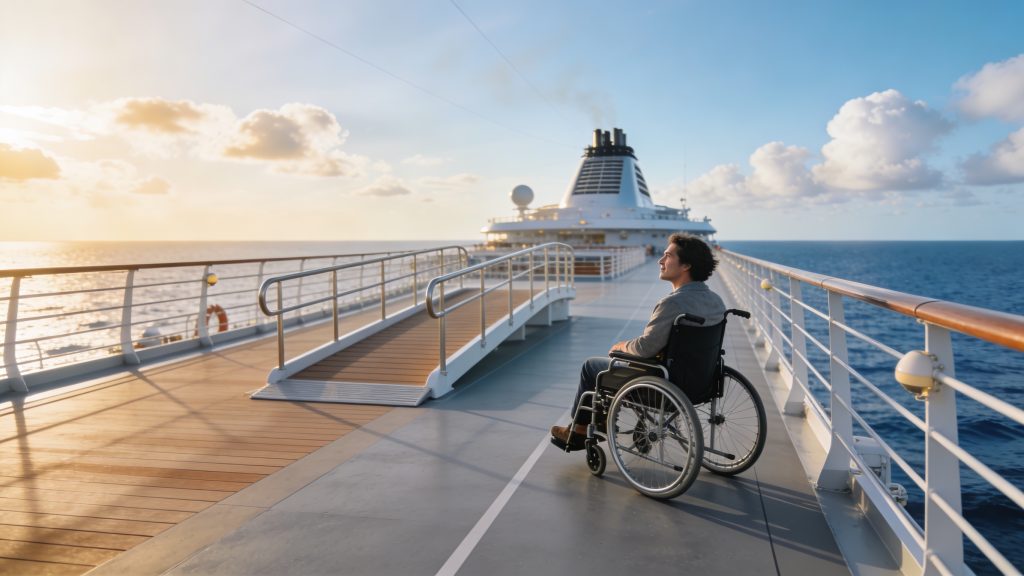
Modern cruise ships offer special cabins for travellers with reduced mobility, with adapted bathrooms, more space to move around and step-free entrances. Cruise lines are investing more and more in accessibility and assistance on board. But how accessible are these cruises really, and what can you expect?
Special cabins for disabled guests
Cruise ships are increasingly offering cabins that are specially designed for guests with reduced mobility. These cabins differ from standard cabins in several ways. The main adjustments are in the layout and facilities.
The bathroom is often the most adapted part. You will find a walk-in shower with a non-slip floor and grab rails, a raised toilet with handrails and enough space to manoeuvre a wheelchair. The wash basin is mounted lower and has space underneath for wheelchair users. All facilities are within easy reach.
The entrance to adapted cabins has no step or raised door sill. This makes it possible to enter and leave the cabin independently with a wheelchair or rollator. The door is often wider than standard, usually at least 80 centimetres. For more information about the different cabins and accommodation on board, you can consult your cruise line’s specifications.
Beds in adapted cabins are often height-adjustable. This makes it easier to transfer from a wheelchair. In addition, there is more space to move around the bed, so there is room for aids or a companion.
‘ Space to move around is the most important criterion. ’
How large are adapted cabins?
The size of accessible cabins varies by cruise line and ship type. In general, adapted cabins are more spacious than standard cabins in order to guarantee enough room to move for wheelchair users.
Most adapted cabins have a surface area between 20 and 35 square metres. That is comparable to a spacious standard cabin or a small suite. Some cruise lines also offer accessible suites of 40 to 50 square metres, with separate sitting and sleeping areas.
Space to move around is the most important criterion. A wheelchair needs a turning circle of at least 150 centimetres in order to manoeuvre comfortably. Adapted cabins are designed so that this space is available both in the sleeping area and in the bathroom.
Bear in mind that not all adapted cabins offer the same level of comfort. Some cabins are located on lower decks without a balcony, while other cruise lines offer accessible balcony cabins with adapted thresholds and raised railings. The price usually falls between that of a standard cabin and a junior suite.
What assistance does a cruise line offer on board?
Cruise lines offer various forms of support for guests with a disability. This assistance starts as soon as you board and continues throughout the entire trip.
On arrival in the port there is often priority at check-in and embarkation. Cruise lines usually have wheelchairs available for use during embarkation and disembarkation. Some ships even have special lifts or ramps to make access easier.
On board, lifts are adapted with pre-programmed buttons at wheelchair height and braille markings for visually impaired guests. Many ships have extra-wide corridors on each deck and automatic doors at key public areas such as the restaurant, theatre and pool deck.
As far as medical support is concerned, there is always a medical team on board. They can help with medication and medical equipment, but they are not a replacement for your own companion or care provider. Dialysis equipment and other specific medical facilities are usually not available as standard. You should request these in advance.
Most cruise lines offer the following forms of assistance:
- Guidance in emergencies with special evacuation procedures
- Requesting special dietary requirements in the restaurant
- Reserving accessible seating in theatres and shows
- Assistance on shore excursions via adapted coaches or accessible activities
- Rental of mobility aids such as wheelchairs or mobility scooters
Always check with your cruise line in advance which specific assistance you need. Not all support is standard and some facilities must be requested at the time of booking.
Are cruise cabins accessible for wheelchair users?
The level of accessibility depends on the type of cabin and the age of the ship. Newer ships comply with stricter accessibility standards than older ships that were built before 2010.
Fully wheelchair-accessible cabins have level entrances, spacious bathrooms with walk-in showers, grab rails by all facilities and enough room to move around. These cabins are often referred to as wheelchair accessible or mobility accessible cabins. They are specifically designed according to international accessibility standards.
In addition, there are cabins with limited accessibility. These cabins do have some extra space and adapted facilities, but are not suitable for all wheelchair users. They may, for example, have a small step or a narrow bathroom door. These cabins are suitable for people with a rollator or reduced mobility, but not always for electric wheelchairs.
When booking, pay attention to the following points:
- Explicitly ask about the specifications of the cabin, such as door widths and turning circles
- Check whether the cabin has a bath or shower and whether it is accessible
- Ask about the location of the cabin in relation to lifts and public areas
- Ask whether the balcony is accessible if you book a balcony cabin
- Check whether emergency exits and muster stations are reachable from your cabin
Not all cruise lines apply the same standards. Larger cruise lines such as Royal Caribbean, Carnival and MSC often have more extensive accessibility programmes than smaller or luxury cruise lines. Always request a deck plan and specifications before you book.
‘ “If you wait to book, you run the risk that all accessible cabins are already reserved.” ’
Why is it important to book early?
The number of adapted cabins on a ship is limited. Depending on the size of the ship, cruise ships have between 10 and 40 accessible cabins. This is a small percentage of the total number of cabins on board.
Because availability is limited, adapted cabins are often sold out quickly, especially during popular seasons and on busy routes. If you wait to book, you run the risk that all accessible cabins have already been reserved.
Booking early has more advantages. You have more choice regarding the location of the cabin. Cabins midship and close to lifts are the most sought-after because they experience less movement and are more accessible. You can also communicate specific wishes for assistance and medical needs, so that the cruise line has time to arrange this.
Some cruise lines offer early booking discounts or have special promotions for accessible cabins. In addition, if you book in good time, you can often still make changes to your reservation without extra costs.

Accessibility in public areas on board
Besides the cabin itself, the accessibility of public areas is very important. Modern cruise ships are designed with wide corridors, ramps and automatic doors at key locations.
Restaurants and buffets usually have enough space between tables for wheelchairs. Some ships have special accessible tables. These offer more legroom and adaptations for wheelchair users. Buffets have dishes and trays placed lower so that everything is within easy reach.
Theatres and show lounges have reserved spaces for wheelchair users. These spaces are often located in strategic places with a good view and easy access. Reserve these seats in advance via reception or the cruise director.
Pools and spa facilities are not always fully accessible. Some ships have an accessible pool with a ramp or lift to enter the water. Spas often have treatment rooms on the main deck, but massage tables are not always height-adjustable. Ask in advance about the options.
Decks and outdoor areas sometimes have raised thresholds or steps at doors leading outside. Newer ships have largely solved this with level transitions. Wooden decks can be challenging for wheelchairs with narrow wheels.
Excursions and port visits for guests with a disability
Shore excursions are often a challenge for travellers with reduced mobility. Not all ports have accessible facilities and not all excursions are suitable.
Cruise lines are increasingly offering accessible excursions. These are marked with a wheelchair symbol in the excursion list. They use adapted coaches with lifts or ramps and visit locations that are accessible for wheelchair users. The pace is often a bit slower and there is more time for breaks.
In some ports you go ashore by tender, which means that you are taken from the ship to the shore in small boats. This can be difficult or impossible for wheelchair users. Cruise lines indicate in advance in which ports tenders are used, so that you can take this into account.
If you book an excursion independently rather than via the cruise line, check whether the provider has experience with guests with a disability. Clearly indicate what support you need and ask about the accessibility of locations and transport.
‘ Explore the website and plan your next cruise with confidence. ’
Discover more about cruise holidays
On the Traveler Tips website you will find much more information about cruise holidays. From choosing the right destination to practical tips on what to pack and how to prepare for your trip. Discover which cruise lines best match your wishes and which routes are most suitable for your journey. Explore the website and plan your next cruise with confidence.
Frequently asked questions
Ask the rail company well in advance whether there is a special assistance service (such as reserving wheelchair spaces or seats with support) and arrange this preferably at the same time as booking your ticket. For each country and operator, check the accessibility information on their website, such as boarding assistance, lifts, guidance lines and accessible toilets. Use European platforms and apps that show the accessibility of stations and trains, and keep confirmations of requested assistance digitally with your travel documents. Allow extra transfer time so that assistance services have the opportunity to guide you in good time when boarding and alighting.
Use platforms and filters that explicitly search for accessibility (such as wheelchair accessible, adapted bathroom, lift, no thresholds) and check floor plans, photos and reviews to see whether these features are actually present. Pay attention to practical details such as threshold heights, door widths, type of shower (walk-in with shower seat), height of bed and toilet, nearby parking and accessibility of the entrance. For each stop on your road trip, look at the distance between the car and the accommodation/attraction, the presence of wheelchair-friendly routes, accessible toilets and any aids available on site. If in doubt, contact the accommodation or attraction directly to discuss your specific needs (type of wheelchair, help needed for transfers, medical aids).
Yes, there are several apps and platforms that provide up-to-date information about the accessibility of routes and facilities, such as Wheelmap (wheelchair-accessible locations) and Ongehinderd (Dutch app with reviews on accessibility). Google Maps also increasingly shows accessibility information, such as wheelchair-accessible entrances and toilets. In addition, some public transport apps and transport operators’ websites offer real-time information about lifts, escalators and assistance services at stations. It is wise to consult several sources at the same time, as the timeliness and completeness can differ per platform.
Many rental companies offer options such as automatic or manual transmission, additional drivers, child seats, snow chains, sat nav and often also vehicles with special facilities for disabled drivers or passengers (for example hand controls or extra wide doors). On the rental company’s website, check the “extras” or “options” sections during the booking process and read the conditions for each adaptation (surcharge, deposit, availability). Reserve the required adaptations directly when booking online and then confirm them by email or phone, especially for medical or mobility-related adaptations. Book as early as possible and store your booking confirmation digitally so you can show it quickly when collecting the car.
Check the accessibility information on each restaurant’s or stopover’s website or app (for example the presence of wheelchair access, adapted toilets and parking). Call or email in advance to discuss your specific needs and, if necessary, ask for photos or floor plans. Use review sites and apps with accessibility filters or ratings to read about the experiences of other visitors with similar needs. Create a personal checklist of your minimum accessibility requirements and tick these off for each location in advance.
Yes, in the Netherlands there are various possible reimbursements and discounts for assistance and adapted facilities, depending on your situation. Via the local authority you can, for example, apply for support or facilities under the Social Support Act (Wmo). Health insurers also sometimes reimburse aids or adaptations, depending on your policy. It is sensible to contact your local authority, health insurer and any benefits agency (for example UWV) to find out what you are entitled to.