 NL
NL
For families with two children, a compact campervan or a semi-integrated motorhome with four berths is the most practical choice. These types of motorhome offer enough space for everyday comfort without compromising on ease of driving or manoeuvrability. A well-thought-out layout with fixed beds, a functional dinette and a fully equipped bathroom makes the difference between a successful or a stressful family holiday. Read on and discover which type of motorhome best suits your family.
Why length and layout matter more than type alone
When choosing a motorhome for a small family, the focus is often on the number of berths. But the layout and total length ultimately determine how pleasant your travels will be. A motorhome of 6 to 7 metres offers enough space for most small families. With this length you remain agile on narrow roads and parking does not become a challenge.
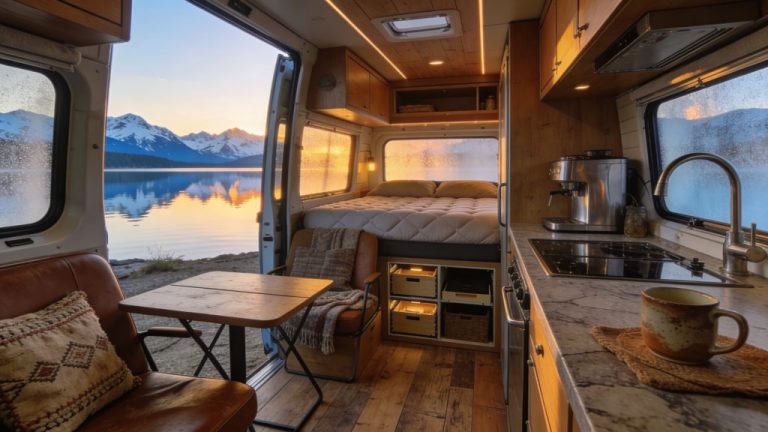
The layout should fit your daily routine. A dinette with enough seating for four people makes shared meals possible. A fixed bathroom with toilet and shower means you are not dependent on washroom buildings at campsites. With young children, having your own bathroom is essential for the morning routine and bedtime rituals.
An overview of all types of motorhome shows the main differences between the options. The choice depends on your priorities: maximum mobility or more comfort and facilities.
Campervan: fully equipped in a compact format
The campervan is a popular choice for small families who want to combine manoeuvrability and comfort. This type offers space for two to four people and is fully equipped with toilet, shower, kitchen and fixed bed. The pop-up roof creates extra interior space and provides a second sleeping place, ideal for children.
The big advantage of a campervan is its manoeuvrability. You drive and park almost as if you were in an ordinary passenger car, which is especially handy in urban areas or on narrow campsite roads. Even so, you still have all the facilities you need for a comfortable holiday.
Pay attention to the layout when making your choice. Test whether the sleeping places offer enough space for your children. Also check the storage space: with four people you will need luggage, toys and extra clothing. Models with smart storage solutions make all the difference.
Advantages of a campervan for small families
- Easy to drive and park, even in tight spots
- Fully equipped bathroom with toilet and shower
- Pop-up roof for extra headroom and a second sleeping area
- Good fuel efficiency compared with larger types of motorhome
- Suitable for both short breaks and longer holidays
Semi-integrated motorhome: balance between luxury and manoeuvrability
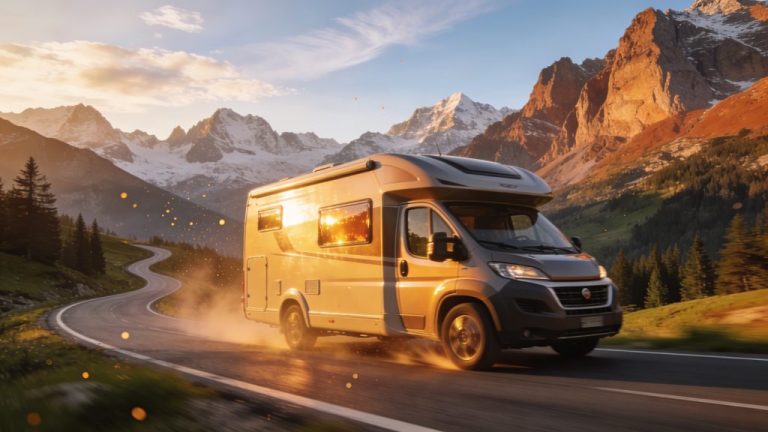
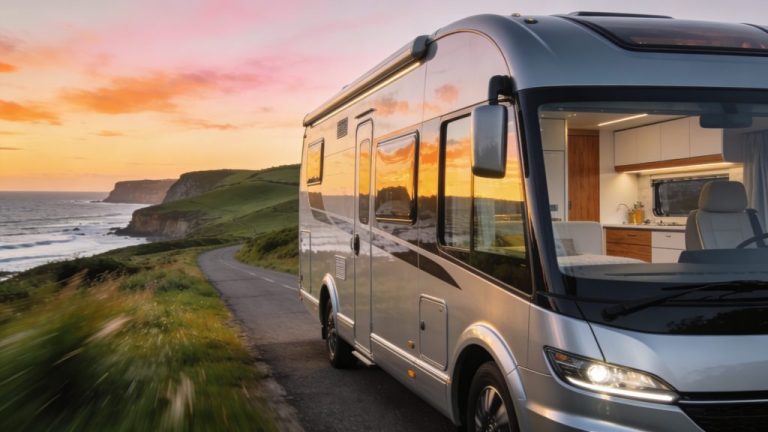
A semi-integrated motorhome offers more living space than a campervan without sacrificing ease of driving. This type is suitable for two to four people and combines a spacious layout with practical facilities. The fixed beds at the rear or side mean no need for daily converting, which is particularly convenient with children.
The semi-integrated motorhome often has an optional drop-down bed above the cab. This increases the sleeping capacity without adding to the overall length. The kitchen is more spacious than in a campervan and the bathroom offers more room to move. For families who cook daily and value hygiene, this is an advantage.
The length of a semi-integrated motorhome is usually between 6 and 7 metres. This makes it suitable for a wide range of destinations, from Alpine passes to coastal towns. Fuel consumption is slightly higher than that of a campervan, but remains acceptable for family holidays.
Why a semi-integrated motorhome is suitable for families
- Fixed beds with no need for daily converting
- Optional drop-down bed for extra sleeping space
- Spacious kitchen and bathroom for extra comfort
- Easy to manoeuvre for long and short trips
- Stable layout that is suitable for children
Overcab motorhome: extra sleeping space and storage
You can recognise an overcab motorhome by the extension above the cab: the overcab. This space provides an extra double bed, which makes this type suitable for families with two children. The overcab is usually generously sized and has a fixed mattress, which increases comfort.
In addition to the overcab, this type has fixed beds at the rear. This means everyone has their own bed without needing to convert the dinette. The living area remains uncluttered and you have more storage space under the beds and in the garage.
An overcab motorhome is slightly higher and longer than a semi-integrated model. This affects the driving experience, especially in windy conditions. Even so, this type is popular with families thanks to its value for money and the generous amount of interior space.
Practical advantages of an overcab
- Extra sleeping area above the cab, ideal for children
- Fixed beds at the rear for parents
- Plenty of storage space under the beds and in the garage
- Spacious seating area and kitchen for families
- Good value for money for family holidays
‘ Test the layout with your family before making your choice. ’
How many metres of motorhome do you need with two children
Most small families manage well with a motorhome between 6 and 7 metres long. This length offers enough living space, four berths and all the essential facilities. At the same time, you remain manoeuvrable enough to drive and park comfortably.
A 6-metre motorhome is compact and suitable for families who consider mobility important. You can manoeuvre easily along narrow campsite roads and park in towns without problems. A 7-metre motorhome offers more interior and storage space, but requires a little more attention when driving.
Test the layout with your family before making your choice. Check whether everyone can sit comfortably at the dinette. See whether the bathroom offers enough space for independent children. Pay attention to the height of the beds and the accessibility of the overcab bed or drop-down bed.
What you should check before choosing
Before you choose a type of motorhome, it is wise to go through a few practical points. This prevents disappointment during your holiday and helps you find a motorhome that suits your family.
Start by testing how it drives. Take the motorhome for a test drive. Assess whether you feel comfortable behind the wheel. Pay attention to visibility, manoeuvrability and how it behaves at higher speeds. Also check the parking options in places you visit frequently.
Look at the layout together with your children. Can they easily get to their sleeping area? Is the bathroom accessible without disturbing others? Is there enough storage space for luggage, toys and food?
Check fuel consumption. Compare this with the distance you plan to travel. For long holidays to Scandinavia or Southern Europe, the difference between 25 mpg and 28 mpg (1 in 10 and 1 in 12 km/l) can quickly amount to several hundred euros.
Key points when making your choice
- Test how it drives and how easy it is to park
- Check whether the sleeping areas are suitable for your children
- Assess the bathroom for accessibility and hygiene
- Look at the storage space for luggage and food
- Compare fuel consumption with your planned travel distance
- Test the ventilation, especially for warm destinations
Which type suits your family best
The choice of motorhome type depends on your priorities. Do you mainly want to stay agile and value simplicity? Then a campervan with pop-up roof is a logical choice. Are you looking for more comfort and don’t want daily converting? Then opt for a semi-integrated motorhome with fixed beds.
If you mainly need plenty of sleeping and storage space and don’t mind a slightly larger motorhome, an overcab model offers the best value for money. For families planning long holidays and who value stability, this type is a reliable option.
Whichever type you choose, make sure the layout fits your daily routine. A functional bathroom, enough seating and easily accessible sleeping areas make the difference between a relaxing holiday and daily irritation.
On the Traveler Tips website you will find much more information about motorhome holidays, routes, preparation and destinations. Discover practical tips that help you plan your holiday more smartly and consciously. Explore the website and prepare your next trip with reliable information.
Frequently asked questions
For a family hesitating between adventurous road trips and relaxed campsite holidays, a flexible travel style is ideal: a mix of touring around with enough rest days at nice campsites. A campervan or semi-integrated motorhome fits this well, as these are manoeuvrable enough for varied routes yet still comfortable on a campsite. When it comes to layout, choose fixed beds (or a fixed rear bed plus drop-down bed) so you don’t have to convert everything every day. A compact bathroom and well-designed kitchen make both short road-trip stages and longer campsite stays more practical with children.
The manoeuvrability and compactness of the motorhome are very important if you plan to drive frequently through narrow streets, villages and mountain roads. A more compact model makes it much easier to park in cities, use tight parking spaces and quickly find a spot near sights. This increases your flexibility to stop spontaneously at beautiful or small places without having to search for long. If you are planning many city trips and visits to small, natural locations, manoeuvrability should therefore be one of the most important selection criteria.
For the comfort of a small family, a private bathroom with toilet and shower, fixed beds so you don’t have to convert everything every day, and a well-equipped kitchen with hob, fridge and sufficient storage space are all but indispensable. In addition, a practical layout with enough living space and seating is important, especially in bad weather or on longer trips.
As a guideline, allow for around 4–5 m² of living space per person on longer trips (from 2 weeks), so that everyone can sit, sleep and get changed without constant converting. For short breaks (a weekend or up to a week) you can manage with 3–4 m² per person if you spend a lot of time outdoors. In terms of storage, you will roughly need 150–200 litres per person for longer trips (clothing, toys, hobby items) and around 100 litres per person for short holidays. For a family of four this comes to about 12–20 m² of effective living space in the layout and 400–800 litres of storage, depending on the length of the trip and how much you take.
We mainly want to use the motorhome as mobile accommodation at the campsite. For getting around locally we prefer to use a smaller (hire) car, bicycles or public transport. We therefore prefer to park the motorhome in one place and not use it as a daily means of transport.