 NL
NL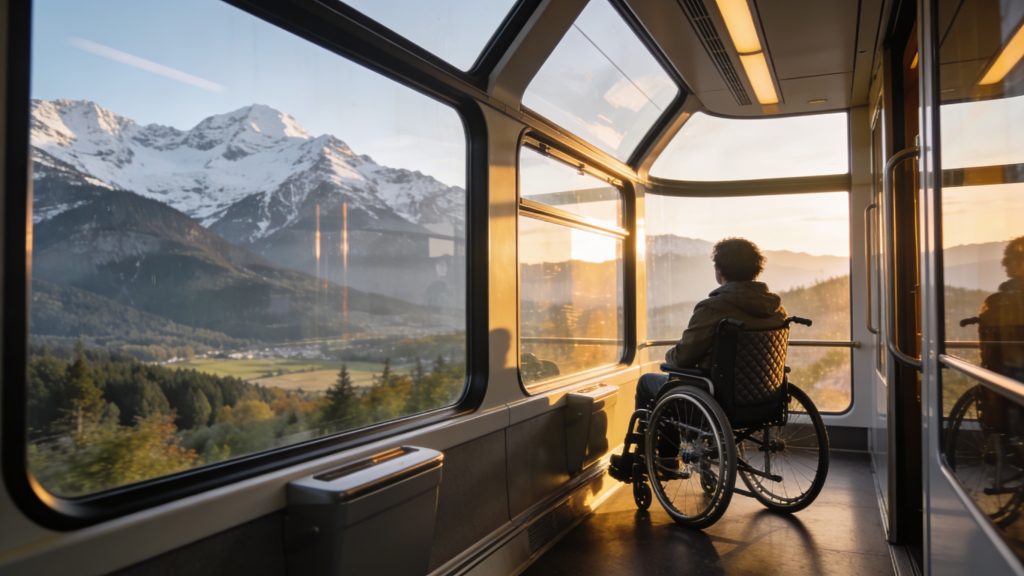
Modern panoramic trains are increasingly accessible for wheelchair users, but the experience varies greatly depending on the route and train operator. With the right preparation and communication before you travel, you can enjoy the most beautiful landscapes without barriers. Below you can read which trains are wheelchair accessible and what you need to arrange in advance.
Which panoramic trains are accessible for wheelchairs?
Not all panoramic trains offer the same level of accessibility. Modern trains have dedicated wheelchair spaces, accessible toilets and assistance with boarding and alighting. Older routes without a reservation system are often harder to access. Many panoramic-train operators are investing in improvements, but it is wise to check in advance what your chosen route offers.
The Glacier Express in Switzerland scores highly on accessibility. This train has reserved wheelchair spaces with room for wheelchairs up to 120 centimetres long and 70 centimetres wide. Trained staff help with boarding, and the toilets are wheelchair accessible. Travellers report that booking via the official customer service is more reliable than boarding spontaneously, especially in high season.
The Nightjet, which has been running with new trains since 2025, also has special compartments for two wheelchair users and two companions. This offers privacy and comfort during overnight journeys through the Alps. Many Swiss and Austrian panoramic trains are now fitted with sliding steps that make boarding easier from platforms of the right height.
In France, Intercités trains with reservations offer wheelchair spaces, but accessibility on regional TER trains is variable. European Sleeper only accepts foldable wheelchairs as luggage, without the possibility to move through the train. This makes choosing an accessible train especially important for a comfortable journey.
‘ This prevents misunderstandings and ensures that the staff are prepared for your arrival. ’
How do you book services for travellers with a disability?
For most panoramic trains, booking wheelchair spaces is compulsory. This guarantees that there is enough room and that assistance is available at stations. Wherever possible, book directly with the train operator or via their official website. This prevents misunderstandings and ensures that staff are prepared for your arrival.
On night trains such as the Nightjet, you can reserve an entire compartment. This provides extra space and privacy, which is useful if you are travelling with a companion. Make sure you provide the dimensions of your wheelchair or mobility scooter so the operator can check whether it will fit into the reserved space.
Many train operators offer assistance with boarding and alighting. You usually have to request this service at least 24 to 48 hours in advance. Also mention any aids such as an electric wheelchair or an assistance dog. Assistance dogs are welcome on most European panoramic trains, and companions often travel free or at a reduced fare.
Use travel apps that only show accessible connections wherever possible. These apps filter trains with wheelchair spaces and give information about lifts and platform heights. Also check the lift status of stations in advance via the website of the relevant railway company.
Are the panoramic carriages themselves accessible?
This is an important issue for many travellers. The panoramic carriages with large windows offer the best views, but are not always fully accessible for wheelchairs. On the Glacier Express, the wheelchair spaces are in carriages with large windows, so you can fully enjoy the views of glaciers, mountain passes and valleys.
On some trains, wheelchair spaces are located near the doors for easy access. This means you will not always be seated in the middle of the carriage, but the views remain impressive. Priority seats provide extra space for companions and are often positioned so that you can still admire the scenery.
Electric wheelchairs and mobility scooters are permitted on modern panoramic trains. However, they must comply with the maximum dimensions of 120 by 70 centimetres. Aids with a combustion engine are not permitted for safety reasons. Take a foldable wheelchair as a back-up for flexible transfers or short walks from stations.
What should you communicate in advance?
Clear communication prevents disappointment and ensures a smooth journey. When booking, provide the train operator with the following information:
- The type and dimensions of your wheelchair or mobility scooter
- Whether you need assistance with boarding and alighting
- Whether you are travelling with a companion or assistance dog
- Which facilities you need, such as an accessible toilet or extra space for luggage
- Any transfers where you require assistance
Where possible, confirm this information in writing by email or via a form on the website. Some operators have dedicated contacts for travellers with a disability. Take their contact details with you on your journey so that you can get in touch directly if you have questions or if anything changes.
Also check the regulations for each country. In Switzerland, almost all stations have been step-free, with lifts and ramps, since 2025. In the Netherlands, the expectation is that all stations will be fully independently accessible by 2030. This makes transferring easier and increases your travel options.
‘ On lower platforms, assistance is required, which you must request in advance. ’
Practical tips for a carefree panoramic train journey
Start by choosing a route that is known for good accessibility. The Glacier Express and the Nightjet both score highly in this respect. Allow plenty of time between transfers so that you can change trains calmly and any delays do not cause problems.
Check the platform height at your departure and arrival stations. At platforms that are level with the train, you can board independently via sliding steps. On lower platforms, assistance is required, which you must request in advance. Be aware that this service is not always available at small regional stations.
Pack light and compact. Bulky luggage can be awkward in combination with a wheelchair. Request assistance with lifting suitcases where necessary. On board there are often special luggage areas near the wheelchair spaces.
Contact the train operator if you are unsure about specific facilities. Travellers report that the staff of the Glacier Express are very helpful, but advise booking two months in advance during busy periods. Another useful tip is to always take a foldable wheelchair with you for flexibility during transfers or excursions from stations.
Regional differences in Europe
Swiss trains are generally very accessible. The country has been investing for years in step-free stations and modern rolling stock. The Jungfrau region around Interlaken even offers unlimited passes for trains, boats and cable cars, all wheelchair accessible. This makes it easy to explore the area beyond the train journey itself.
In Austria, the Nightjet sets the standard for accessible overnight travel. The new trains from 2025 onwards have compartments for multiple wheelchair users and their companions. Here too, advance reservation is compulsory.
France presents a mixed picture. Intercités trains with the ARO system offer good facilities, but regional trains are often less accessible. Check in advance whether your chosen route accepts reservations and has wheelchair spaces.
European train operators are working on further improvements. New trains prioritise inclusivity and comfort for all travellers. This is making panoramic trains increasingly attractive for people with reduced mobility.
Additional facilities and combined options
Many panoramic trains offer accessible toilets with floor markings for easy positioning. These toilets can be reached from the wheelchair spaces without barriers. In first class you often pay the second-class fare for a wheelchair space, which makes the journey more affordable.
Combine your train journey with other accessible modes of transport. Regional buses and cable cars in Alpine areas are often also wheelchair accessible. This gives you the opportunity to discover not only the train journey itself but also the surrounding sights.
Be aware of exceptions and limitations. Not all trains accept electric mobility scooters, and some older routes do not have guaranteed assistance. Always ask the train operator for the most up-to-date information, as facilities can vary depending on the season and train series.
On the Traveler Tips website you will find much more information about rail holidays, routes and practical planning. From regulations to equipment and the most beautiful destinations: discover how to make every journey accessible and comfortable.
Frequently asked questions
Always reserve a wheelchair space and assistance in advance via the official customer service or booking page of the relevant panoramic train (for example Glacier Express), because wheelchair spaces are limited and often must be reserved. When booking, clearly indicate that you need a specific wheelchair space and state the dimensions of your wheelchair. Explicitly request assistance with boarding and alighting, including at any transfer stations. A few days before departure, reconfirm your reservation and the assistance with the train operator.
Panoramic trains generally have specially designed wheelchair spaces with extra wide and clear space to move around, often directly next to the window. Many modern panoramic trains have wheelchair-accessible, enlarged toilets with sufficient turning space and markings for positioning the wheelchair. Entrances and gangways are low-threshold or level, making it easier for wheelchair users to move through the train. In addition, train staff usually provide boarding and alighting assistance from platforms that are equipped for this.
Yes, in modern panoramic trains such as the Glacier Express, the panoramic view from the wheelchair spaces is generally excellent, because these seats are located directly by the large windows. The Glacier Express is often mentioned as one of the best choices in terms of views and accessibility (special wheelchair spaces, assistance and accessible toilets). The newest Nightjet trains also offer a good experience, especially for night and dusk panoramas, with special wheelchair compartments. In all cases, reserve a wheelchair space explicitly in advance to be sure of the best position by the window.
Yes, most panoramic trains have maximum dimensions for wheelchairs, often around 120 cm long and 70 cm wide. Both manual and electric wheelchairs are generally allowed as long as they fall within these dimensions. Aids with a combustion engine (for example certain scooters) are usually not allowed. It is advisable to book in advance with the relevant train operator and check the specific conditions.