 NL
NL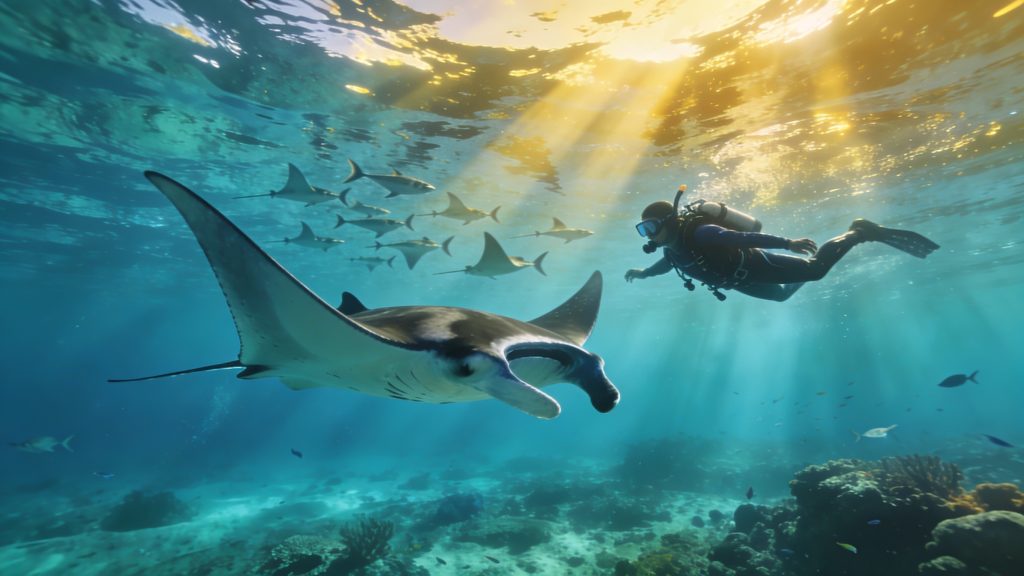
Diving with manta rays and mobulas is one of the most impressive experiences you can have underwater. These majestic giants have wingspans of up to seven metres. They glide gracefully through the water and offer you an encounter you will not soon forget. You might opt for the shallow waters of Bali, or head to the remote sites of Raja Ampat or the Atlantic dive areas around the Azores. This experience calls for thorough preparation. Discover where you can spot these animals, when it is best to go and how to plan your dive trip responsibly.
What are manta rays and mobulas?
Manta rays and mobulas belong to the Mobulidae family. These are cartilaginous fish. They feed on plankton. The main difference between the two lies in the position of the mouth. Manta rays have their mouth at the front of the head. Mobulas have their mouth on the underside. In addition, manta rays grow considerably larger than mobulas.
Reef mantas reach a wingspan of up to four metres. Oceanic mantas measure up to seven metres. Mobulas remain more compact in size. These animals migrate to plankton-rich waters, often around islands and coastal areas between 35 degrees north and south. They regularly visit cleaning stations, where small fish remove parasites from their skin. This behaviour makes them easy for divers to observe.
Each individual has unique patterns on its back. These patterns work like a kind of fingerprint. They are gentle and not shy. They dive to depths of up to one thousand metres, yet often feed at the surface. This makes them accessible to both divers and snorkellers.
Where can you see manta rays and mobulas on your diving holiday?
There are several top destinations around the world where you can spot manta rays and mobulas. Your diving experience plays a role in your choice, and the time of year also determines which destination is suitable. If you are planning a full diving holiday, it is important to know the seasonal patterns. Local conditions influence your chances of sightings.
Nusa Penida, Bali
This Indonesian dive area is accessible all year round, with a peak between August and October. Manta Bay and Manta Point are the best-known spots for reef mantas, and this is also where you can see the rare black morph. Depths vary from five to twelve metres. Snorkelling is possible here too. Strong currents occur regularly, so this location is not suitable for absolute beginners.
From Sanur you reach Nusa Penida by speedboat. The crossing takes about one hour. Book with PADI-certified operators (Professional Association of Diving Instructors) or SSI-certified operators (Scuba Schools International) for safe guidance. You often see manta rays swimming from the boat already, which makes for spectacular moments before you even get into the water.
Raja Ampat, Indonesia
This remote archipelago is accessible from October to May, with the best months from December to March. Well-known dive sites include Manta Ridge and Blue Magic. Here you can see reef mantas and oceanic mantas, including rare black variants. The currents can be strong, so this area is suitable for advanced divers.
Raja Ampat offers vast coral gardens. A liveaboard is highly recommended to reach remote sites, allowing you to dive several days in a row. Flights run via Sorong.
Socorro Islands, Mexico
From January to May you will find enormous oceanic mantas here. This destination requires liveaboard diving, with deeper dives in open water. It is suitable for advanced divers. In the summer months you can encounter large schools of mobulas in the Sea of Cortez.
Azores, Portugal
This archipelago in the Atlantic Ocean offers chances to see manta rays and mobulas. Opportunities are seasonal. Boat diving is essential. This destination is suitable for advanced divers who are used to cooler waters.
Other top locations
There are also a few other worthwhile destinations:
- Tofo and other dive locations in Mozambique offer cleaning stations with manta rays all year round. The sites are suitable for all levels.
- Ticao Island in the Philippines has Manta Bowl as a famous spot, where you can also encounter whale sharks. Note: snorkelling is not allowed here on manta dives.
- Yap in Micronesia is famous for night dives. Lights attract plankton, which manta rays feed on indirectly.
- Ishigaki in Japan offers friendly encounters from May to December at Kabira Bay and Manta Scramble. Only a limited number of boats are allowed, ensuring more intimate experiences.
- The Maldives and Kona in Hawaii are well-known manta hotspots.
When is the best season for manta diving?
In Indonesia, April to November are favourable months, with peaks around August to October for Bali. Raja Ampat follows a different pattern, with optimal conditions between December and March. For Socorro, choose the period from January to May.
Atlantic destinations such as the Azores have different patterns again. Manta rays migrate to plankton-rich areas, so plan your trip according to this migration. Peak seasons are popular: book early. Popular dive operators are quickly fully booked. Always check the local weather conditions and visibility before you book.
How do you prepare for a manta diving holiday?
Good preparation increases your chances of successful sightings and results in a safer experience underwater. Choose a certified dive operator. Check whether they are PADI-certified (Professional Association of Diving Instructors) or SSI-certified (Scuba Schools International). Ask about their experience with manta diving.
Check your own dive level and compare it with the requirements of your chosen destination. Some sites require experience with strong currents, where drift diving is necessary. If you are prone to seasickness, take medication with you, especially for longer boat trips to remote sites. Bring reef-safe sunscreen to help protect the ecosystem.
Behaviour rules underwater
Always keep five metres away from the animals. Never touch manta rays, even if they come close. Sometimes they swim up to divers, interested in the bubbles coming from your regulator, which they associate with cleaning behaviour. Let them set the pace and direction.
Choose operators with clear no-touch rules. This protects the animals and increases the chance that they will return to the same sites. Avoid sudden movements. Stay calm in the water.
‘ Some locations, such as Ticao Island, only allow diving when manta rays are being observed. ’
Snorkelling or diving with manta rays?
Snorkelling works well in shallow bays such as Manta Bay at Nusa Penida, where depths range between two and twelve metres. Non-divers are welcome here, as are families. You have less control over your position and you depend more on surface conditions.
Diving offers deeper interactions and more control. You can stay in one place for longer and get closer to cleaning stations. Some locations, such as Ticao Island, only allow diving, not snorkelling, when manta rays are being observed. There are plenty of accessible dive spots for beginners. Always check the current and local conditions.
How can you help protect manta rays?
Manta rays are vulnerable due to bycatch and habitat loss. Pollution also threatens these animals. You can contribute to their protection by making conscious choices. Choose dive operators who are committed to sustainable tourism and do not allow physical contact. Support local nature conservation projects where possible.
The Manta Trust works to protect manta rays worldwide. This international organisation collaborates with local partners and offers programmes in which citizens contribute to scientific research. Divers share photographic sightings; these photos help identify individual animals by their unique back patterns. You contribute to scientific research, and all it costs you is a photo.
Report sightings to local organisations. Respect closed areas and closed seasons, which protect vulnerable populations. Avoid operators who lure animals with food, as this disrupts their natural behaviour.
What does a manta diving holiday cost?
Your destination largely determines the cost, and the type of trip also plays a role. Day trips from local dive centres cost an average of 75 euros per dive, usually including boat transport, guidance and dive equipment. For destinations such as Bali or the Philippines, these are affordable options.
Liveaboards to remote areas start at around 200 euros per day for destinations such as Socorro or Raja Ampat. These multi-day trips offer more dives and a higher chance of sightings. Air fares are extra, as are accommodation and insurance. Plan a generous budget. Compare operators on price and always check reviews.
‘ Many operators are fully booked months in advance. ’
Practical tips for your trip
Combine your diving holiday with culture and nature in the region. Bali, for example, offers culture in Ubud, temples and rice terraces. From Europe you can fly directly to Denpasar. For Raja Ampat, plan extra travel time via Jakarta or Makassar to Sorong.
Check visa requirements before you depart and make sure your vaccinations are up to date. Indonesia has different requirements from European destinations, as do the Philippines. Download weather apps for up-to-date conditions. Ask dive centres for visibility reports (information about underwater visibility). Allow a few extra days in your schedule: weather-related delays do occur, especially in monsoon seasons.
Book your dives in advance during peak seasons to avoid disappointment. Many operators are fully booked months ahead. Take underwater photography equipment so you can capture the unique patterns. You can use these photos for scientific research.
On the Traveler Tips website you will find information about dive destinations and visa requirements, as well as itineraries and preparation for nature holidays. Discover more about dive locations around the world and plan your next trip with reliable tips and practical guidance.
Frequently asked questions
Within Europe, the Azores (Portugal) are the only explicit top destination from the guide where you can get reasonably far by car/train in combination with a short flight or ferry, but not entirely without flying. The other highlighted top destinations for manta rays and mobulas – such as Nusa Penida (Bali), Raja Ampat, Socorro, Ticao, Yap, Ishigaki, the Maldives and Kona (Hawaii) – all require intercontinental flights and therefore are not realistically reachable purely by car or train.
The optimal time to travel for spotting manta rays and mobulas differs per destination, but many hotspots have peak seasons: for example Raja Ampat from roughly October to May (with a peak around December–March) and Nusa Penida, where there are chances all year but conditions are often better in the second half of the year. Keep an eye on climatic seasons: monsoon periods, rough seas or stronger currents can affect visibility and safety. Peak crowd periods often coincide with the best season and school holidays; popular places like Nusa Penida and Kona can then be very busy with boats. For a quieter experience, travel outside school holidays, dive early in the day or choose more remote locations or liveaboards.
Combine your dives with manta rays and mobulas with cultural stops such as Ubud (rice terraces, temples) or historic towns in the region for a varied road trip. Add natural highlights such as volcanoes, waterfalls or national parks for hiking and wildlife spotting on days between dives. Also plan time for local villages, markets and street food to experience the local culture and cuisine. Finish your route with a few relaxing days on a quiet beach or island to recover from the intensive dives.
It is essential to have at least a valid basic diving certificate (preferably with some experience in current or drift dives) and to choose a recognised PADI/SSI operator that provides clear safety briefings and ‘no-touch’ guidelines. Make sure your equipment fits well and is properly maintained: a balanced BCD, reliable regulator, sufficient weights and, ideally, your own mask and snorkel; check everything before the boat leaves. Take practical extras such as seasickness tablets, reef-safe sunscreen, a well-fitting wetsuit to prevent getting cold and chafing, and a dive torch for possible night dives. Underwater, stay calm, keep at least 3–5 metres distance, do not touch animals or reef, and follow the guide’s instructions strictly for a comfortable and safe experience.
The average costs for day trips to dive with manta rays and mobulas are roughly between €50 and €100 per day, while liveaboards often start at around €200 per day. You can plan on a budget by choosing day trips in easily accessible regions (for example Bali or the Philippines) instead of expensive, remote liveaboards. Save on luxury accommodation and pricey extras, but not on a well-reviewed, certified dive school with small groups. Travel outside the absolute high season and book in advance so you get better prices without compromising on quality or experience.