NL
NL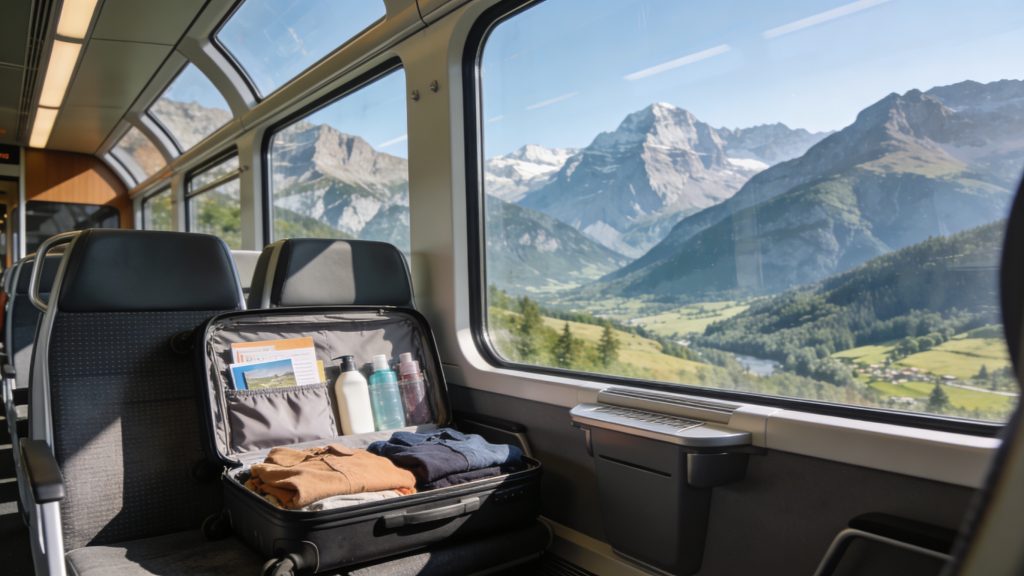
Panoramic trains offer spectacular views, but your comfort largely depends on how you pack your luggage and what you take with you. Remember that luggage space on board is limited and that you will often need to change trains. A thoughtful approach prevents hassle on the way and ensures you spend more time enjoying the views than lugging suitcases around.
Choose light and flexible luggage
For panoramic train journeys, a hard-shell suitcase is often less practical. A soft holdall or rucksack works better. This is due to the limited space around seats, narrow aisles and the fact that you sometimes have to carry your luggage yourself when changing trains.
Ideally, take one compact main piece of luggage. Use a small daypack for your most important items.
Keep your luggage as light as possible. This makes it easier to move along narrow platforms or when dealing with changing step heights while boarding and alighting.
Are you travelling on one of the scenic rail: panoramic trains and most beautiful train routes? Flexible luggage is then more practical than large, heavy suitcases.
‘ You must be able to carry and store your luggage yourself. ’
How much luggage can you take?
On most European panoramic trains there is no strict weight limit as on planes. There is, however, a practical limitation. You must be able to carry and store your luggage yourself.
Many rail companies advise a maximum of one large piece of luggage per person. In addition, you may take one small piece of hand luggage.
Check the rules of the specific rail company in advance. You will find this information on the website or with your reservation.
On some routes through Switzerland, Norway or Austria, additional guidelines apply. These guidelines relate to luggage in panoramic carriages.
Where can you store luggage on board?
Panoramic trains do have luggage space, but it is often limited and fills up quickly when the train is busy. You will usually find storage spaces in the following locations:
- Racks above the seats
- Space at the ends of the carriage
- Spaces between seats or by doors
- Sometimes a separate luggage carriage
Place your luggage in a safe spot immediately after boarding. Always keep valuables such as your phone, wallet and documents with you.
Use a small lock for extra security. A luggage label is also recommended.
Put heavy items at the bottom of your bag. Keep only what is necessary in your daypack.
Book in good time for the best seats
On many panoramic trains a seat reservation is compulsory. That often applies to the panoramic carriages.
Booking early prevents you ending up without a seat. It also gives you more choice of carriage type and departure times.
If possible, choose a window seat and preferably in a carriage with large windows. Travelling with several people? Check whether you can sit together.
On routes with several segments, you need a separate reservation for each section.
What should you take – and what not?
Travel light. Only take what you really need.
Think carefully about what you want to use on the way. Also consider what you will only need once you reach your final destination.
Useful things to take
- Passport or ID card
- Tickets and reservations, also stored offline
- Water bottle
- Snacks
- Power bank and charger
- Earplugs or headphones
- Sunglasses
- Light jumper or scarf
- Small toiletry bag
- Camera or phone with enough storage space
- Medication you need
Preferably not, or only if really necessary
- Large, heavy suitcases
- Loose shopping bags
- Several rucksacks
- Fragile souvenirs for on the way
- Heavy laptops or unnecessary electronics
Dress in layers for changing comfort levels
On panoramic trains, the temperature often fluctuates. This is due to the large windows. Air conditioning and changes in altitude also play a role.
Wear several layers of clothing on top of each other. Wear a breathable base layer, such as a T-shirt. Combine this with a jumper or cardigan. Also take a light jacket or scarf.
Choose comfortable clothing. That way you can sit in it for hours without becoming stiff.
Wear shoes that are easy to walk in. This is especially important if you have to change trains. It is also handy during stopovers.
Many travellers underestimate the temperature on a train. A train often feels cool. This is especially true on mountain routes and longer journeys.
Take your own food and drink
Not every panoramic train has extensive catering. Sometimes the options are limited. Sometimes they are pricey.
It is a good idea to take something yourself. Choose water, fruit and sandwiches. Nuts and muesli bars are handy as well.
Ideally take food that does not crumble. Also avoid food with a strong smell.
Keep the carriage tidy. Choose snacks that create little mess. Make sure your snacks are not bothersome for fellow passengers.
Pack your food in a reusable bag or box. Choose packaging that you can close easily.
Use a small on-the-go kit
A handy trick is a small kit with items you need immediately while travelling. You will then have these things within easy reach.
Do not put this kit in your large suitcase. Keep it in your daypack.
That way you do not have to rummage through your luggage every time the train is moving. You will also have everything at hand straight away when changing trains.
Think of:
- Tickets and documents
- Phone and charger
- Power bank
- Passport or ID card
- Lip balm and hand gel
- Tissues
- Headphones
- Sunglasses
- Snacks and water
Make your luggage easy to move when changing
Many scenic routes consist of several sections. On some routes you change onto another train, a boat or a regional train.
Carry a rucksack on your back. Keep one wheeled suitcase or soft bag in your hand.
Choose luggage with good wheels. Attach labels to every bag.
Store important items in one separate compartment. You will then be able to access them quickly.
Do you have to change trains often? A soft bag is then usually easier to handle. A hard suitcase is less practical in that case.
Keep valuables close to you
Panoramic trains are generally safe. Still, as everywhere else, it is better not to leave your valuables unattended.
Always keep your phone, wallet and documents with you. It is also best to keep your camera close to you.
Do not leave a laptop or camera lying around. Use a bag that you can close quickly.
Do not leave luggage out of your sight. Always keep your luggage within arm’s reach.
Be extra alert on busy routes. Alertness is also important in popular tourist areas.
‘ On routes through Switzerland, documents are important. ’
Check your documents for international journeys
On routes through Switzerland, documents are important. You also need your documents in Austria and Norway.
Check in advance whether your ID card or passport is valid. Check whether your reservation is in your name.
Check whether your rail pass or ticket is valid in the correct class. Also check whether the ticket is valid on the correct route.
Ensure you have offline access to tickets and reservations when travelling by train through several countries. Download them onto your phone beforehand. Also print them out as a back-up.
Practical tips from travellers’ experiences
Travellers who regularly use panoramic trains recommend the following:
- Book early for the best seats and prices
- Travel outside peak times if possible
- Do not take an overly large suitcase
- A soft bag or rucksack usually works better
- Ensure quick access to snacks, water and documents
- In busy periods, allow extra time to find your seat. Also allow time to store your luggage.
On the Traveler Tips website you will find much more information about train travel, routes and practical preparation.
Before departure, always check the current regulations and reservation conditions of your rail company. Allow sufficient transfer time and consider doing a trial pack a few days before departure to check whether you can easily carry everything.
Frequently asked questions
Use one compact suitcase or soft bag for the main luggage area and keep only a small daypack by your seat. Place large luggage in the racks at the ends of the carriage or in the designated luggage compartment, not in front of the window or in the aisle. Put everything you need during the journey (tickets, water, snacks, camera) in your daypack so you do not need to open your large bag. Make sure valuables always stay with you and label or lock your larger luggage.
A compact soft travel bag or sturdy rucksack is the most practical, because you can easily carry it and it fits into narrow aisles and overhead racks. A small (soft) trolley with good wheels can also work, as long as it is not too large or heavy. Soft luggage fits better into varying luggage spaces than hard suitcases. Ideally combine this with a small daypack for your valuables and frequently used items.
Your hand luggage should at least contain your passport/ID, tickets (also offline), phone with charger/power bank and wallet, plus any medication and a small toiletry bag. For comfort, a bottle of water, light snacks, a jumper or scarf (layers), sunglasses and lip balm are useful. Take earphones or headphones for peace and quiet, and possibly a camera or phone with enough storage for photos. Put everything you need on the way in a small, well-closing daypack that fits on or under your seat.
Yes, on panoramic trains there are often limited racks above the seats and luggage spaces at the ends of the carriages, which is why compact and soft luggage is strongly recommended. Large hard suitcases can be more difficult to store and make boarding and changing trains in narrow aisles more awkward. You are best keeping valuables in a small day rucksack with you, so that you do not constantly have to access your main luggage. Also check in advance whether there are special reservation rules on your route for certain carriages or sections, so that you are sure of a seat and enough space.