NL
NL
A train journey along the historic Hanseatic cities in the Netherlands and Germany combines cultural heritage with cross-border slow travel. You travel from Kampen and Deventer via Münster to Bremen, discovering compact old town centres, cycle routes and the atmosphere of centuries-old trade networks by IC train. Direct and regional train connections make this route accessible without needing a car. Read on and find out how to plan this cultural route yourself.
Why choose a train route along Hanseatic cities?
The Hanseatic cities formed a trading alliance across Northern Europe for centuries. In the Netherlands and Germany, dozens of these historic cities are within train distance of each other. A multi-day route along these places is very appealing. You alternate old merchants’ houses, mediaeval city centres and river landscapes with short international journeys. The route is flexible: you choose which cities you want to visit and how many nights you stay in each place.
By using international train routes between the Netherlands and Germany, you can avoid taking a plane. You board in Deventer or Zwolle and combine long-distance sections with regional connections. This makes the journey suitable for conscious travellers who want to see more than just a single final destination.
‘ There are, however, four core cities that together form a logical travel concept. ’
Which cities are on this route?
The route has no fixed order. There are, however, four core cities that together form a logical travel concept. You can start and end the route wherever you like. Below is an overview of the main cities and what makes them special.
Kampen and Deventer
Kampen and Deventer are Dutch Hanseatic cities with well-preserved old centres. In Kampen you can see mediaeval gates and historic façades along the river IJssel. Deventer, in addition to the Bergkerk, has a compact city centre where shops and hospitality venues blend with merchants’ houses from the 15th and 16th centuries. Both cities lie on the railway line between Zwolle and Arnhem, which makes continuing on to Germany easier.
Münster
Münster is a German university city in North Rhine-Westphalia and an important hub for cycle routes. The city has a historic centre with the Prinzipalmarkt and town hall, where the Peace of Münster was signed. You can reach Münster from the Netherlands via Enschede or Hengelo. The train connection between Enschede and Münster is operated by regional trains, with services usually arriving at Münster Hauptbahnhof.
Bremen
Bremen lies in the north of Germany and is one of the most important Hanseatic cities in the region. The city centre around the Marktplatz and the Schnoor quarter is compact and easy to explore on foot. Bremen is reachable from Münster by long-distance trains, with a journey time of around two hours. From Bremen you can return to the Netherlands via Zwolle or continue on to Hamburg and Lübeck.
What does the train timetable look like?
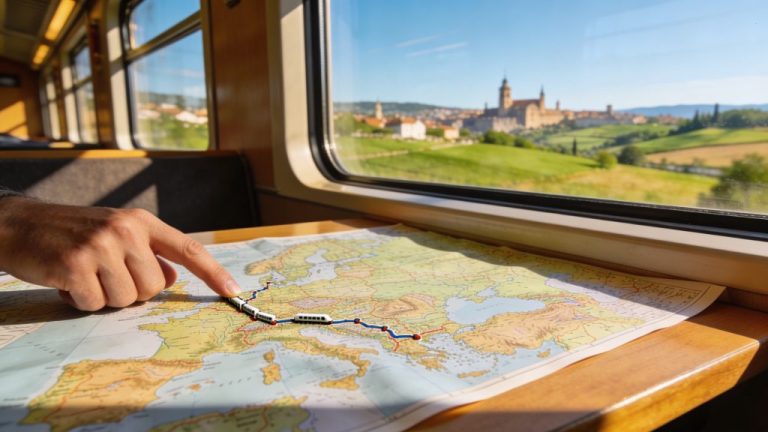
There is no single through train line for this route. You combine different sections with changes at border stations or hubs. Below you can find the main connections with indicative journey times:
- Deventer – Enschede: around 1 hour by regional train
- Enschede – Münster: around 1 hour by cross-border stopping train
- Münster – Bremen: around 2 hours by IC train
- Bremen – Zwolle: around 3 to 3.5 hours via various IC connections and changes
It is best to build in some extra time for transfers, especially in Arnhem, Zwolle or Münster. Many connections come together at these stations. Check the current timetable via the NS International website or the DB Navigator app. Timetables differ by season and day of the week.
Can you take your bike on this route?
Taking a bike depends on the type of train and the cross-border rules. In Dutch IC trains and regional trains, bikes are allowed outside peak hours, provided there is space. You need a bicycle ticket, which you buy from NS.
A similar system applies on German trains. On regional trains (RB, RE), bikes are usually allowed with a Fahrradkarte, a separate bike ticket. On IC trains run by Deutsche Bahn you sometimes need to reserve a bike space in advance, especially on busy routes. When buying your train ticket, ask about the conditions for your specific journey.
As an alternative, hire a bike at your destination. In Münster and Bremen there are bike rental points at the station. This saves hassle with transfers and reservations and makes you more flexible during multi-day trips.
What are the hotspots in each city?
Each Hanseatic city has its own character and sights that can be visited in half a day or a full day. Below you will find the main hotspots for history and culture in each city.
Hotspots in Kampen
- Koornmarktspoort and Cellebroederspoort: mediaeval city gates on the river IJssel
- Oude Raadhuis: Gothic town hall from the 14th century
- Bovenkerk: impressive church with a tower offering views across the city
- IJsselkade: riverside promenade along the IJssel with historic warehouses
Hotspots in Deventer
- Brink: central square with weekly market and historic façades
- Bergkerk: mediaeval church with the option to climb the tower
- Waag: former weighing house, now a museum
- Stately merchants’ houses along Walstraat and Korte Bisschopstraat
Hotspots in Münster
- Prinzipalmarkt: arcaded square with gabled façades and shops
- Historisches Rathaus: town hall where the Peace of Münster was signed
- St. Paulus Dom: cathedral with astronomical clock
- Aasee: city park with lake, ideal for walks and cycle rides
Hotspots in Bremen
- Marktplatz with town hall and Roland statue, both UNESCO World Heritage Sites
- Schnoor quarter: narrow alleyways with half-timbered houses and artisan shops
- Bremer Stadtmusikanten: bronze statue based on the Brothers Grimm fairy tale
- Böttcherstraße: art street from the 1920s with museums and galleries
Budget tips for a multi-day Hanseatic train trip
Smart choices in tickets, accommodation and planning keep a multi-day train journey affordable. Where possible, choose transport options with early booking discounts. Compare accommodation within walking distance of stations. Plan quieter travel days in the shoulder seasons. Below you will find concrete tips to help you keep costs down.
Tickets and travel costs
Consider an Interrail pass if you want to travel several sections within Germany. An Interrail One Country Pass Germany is valid on domestic German trains and can be cheaper than separate tickets. For cross-border sections, buy individual tickets via NS International or the DB Navigator app. Book early: many international connections offer Sparpreis tickets that are up to 50 per cent cheaper than flexible fares.
Avoid travelling during weekend peaks and public holidays, as trains are busier and prices higher then. Travelling on weekdays in the shoulder seasons often gives you better fares and more availability.
Overnight stays
Opt for hostels, B&Bs or budget hotels near the station. In cities like Münster and Bremen, central hotels are often more expensive than accommodation just outside the centre. Check whether your accommodation is within walking distance of the station, so you do not incur extra costs for public transport or taxis.
Book overnight stays with free breakfast included. This saves both time and money, especially if you want to leave early for your next train leg.
Food and drink
Lunch and dinner close to tourist hotspots are often pricey. Walk a few streets further or visit local markets for fresh produce and snacks. In Münster and Bremen you will find inexpensive student cafés and bakeries around the university districts.
Bring a refillable water bottle. Tap water in the Netherlands and Germany is of good quality and saves you from having to buy plastic bottles.
How do you plan this route in practice?
First choose your starting and finishing point. If you are departing from the Netherlands, Deventer and Zwolle are logical starting points. Then decide how many days you want to travel and how many nights you want to stay in each city. A rhythm of two nights per city gives you time for a relaxed exploration without rushing.
Create an itinerary with transfer times and check whether reservations are required for certain sections. Keep your train tickets digitally in an app or print them out as a back-up. Allow for time differences, even though the Netherlands and Germany are in the same time zone: local times in timetables can sometimes differ due to summer and winter time.
Make sure you have an overview of your accommodation, including addresses and contact details. This makes it easier when you arrive at a new station, especially if you arrive late or are delayed.
‘ That helps you see the main sights without wandering around aimlessly. ’
Cycling and walking around the Hanseatic cities
Many Hanseatic cities lie on rivers or near cycle networks. In Münster and Bremen, bike hire and signposted routes are standard. The Hanseatic Cycle Route (Hanzefietsroute) runs past several cities on this railway route. It is a long-distance cycle path through the Netherlands and Germany. You can combine parts of a day: take the train to the next city, hire a bike and explore the surrounding area.
Walking routes through city centres are often freely accessible and well signposted. At the VVV office or tourist information bureau, ask for a city map with a walking route. That helps you see the main sights without wandering around aimlessly.
Discover more routes and tips
On the Traveler Tips website you will find much more information about train journeys, international routes, packing tips and budget planning for multi-day trips. Whether you are planning your first train journey or already have experience with cross-border travel, there is always something new to discover. Explore the website and get more out of your next trip.
Frequently asked questions
Which ‘Hanseatic cities’ in the Netherlands and Germany should I absolutely not miss on this train journey, and why?
In the Netherlands you should not miss Deventer and Zwolle: compact, atmospheric city centres with mediaeval streets and views of the IJssel, perfectly reachable by intercity. In Germany, Lübeck and Bremen are real highlights: Lübeck with its distinctive city gates and brick Gothic architecture, Bremen with the historic Marktplatz and the famous town musicians. Cologne is a logical stopover thanks to the cathedral right next to the station and the many direct international train connections. Finally, Hamburg combines Hanseatic history with modern architecture around the Speicherstadt and HafenCity, ideal as a larger final destination or intermediate hub.
How do I plan the ‘Hanseatic cities train route’ smartly and efficiently in terms of travel time, overnight stays and connections?
Start by choosing a logical loop, for example Deventer – Ghent – Cologne – Hamburg – Lübeck – Bremen – Zwolle, and plan a maximum of 2 to 3 cities per day so that travel time and visiting time stay in balance. Use journey planners (NS International, DB Navigator) to optimise connections between long-distance and regional trains and build in a 20–30 minute buffer at international connections. Book overnight stays preferably close to the station at hubs such as Cologne, Hamburg and Bremen, so you remain flexible in the morning if there are delays. Consider an Interrail or flexible international ticket, so you can shift sections if you want to stay longer somewhere.
What are the most practical ‘train tickets’ and ‘passes’ for travelling comfortably and affordably on the ‘Hanseatic cities route’ in the Netherlands and Germany?
For a flexible Hanseatic cities route with several stages, an Interrail Global Pass or Interrail Benelux–Germany (where available) is often the most practical and cost-effective, as it allows you to hop between Dutch and German cities without limit on selected travel days. If you are mainly travelling within the Netherlands, NS day tickets or an NS Flex subscription (for example Dal Voordeel) are useful; in Germany, regional Länder tickets (such as the Niedersachsen-Ticket or NRW-Ticket) and the Deutschland-Ticket (for longer stays) are attractive for inexpensive regional journeys. For separate, longer IC/ICE sections (for example Cologne–Hamburg), Sparpreis or Super Sparpreis tickets from Deutsche Bahn booked early can be cheaper than a pass. You can also combine an Interrail or Deutschland-Ticket with separate reservations for long-distance trains to be sure of comfort and a seat.
Which ‘preparation tips’ are essential for a carefree ‘Hanseatic cities train journey’, such as luggage, reservations and apps?
Essential items are a light, easy-to-carry suitcase or rucksack and layered clothing, as you will often be getting on and off trains and travelling through different climate zones. Reserve long-distance and international trains (such as Cologne–Hamburg) well in advance, and allow more time for transfers at hubs like Cologne and Arnhem. Download the NS International/Deutsche Bahn apps and a route planner (for example for transfer times and platform information), plus an offline maps app for the Hanseatic cities themselves. Keep tickets and reservations both digitally and printed out, so that you can always show your travel documents if you have battery or internet problems.
Are there particular ‘travel times’ or ‘seasons’ that make the ‘Hanseatic cities train route’ especially special, or that are best avoided?
The Hanseatic cities train route can be done all year round, but really comes to life in spring and early summer, when terraces, river landscapes and historic centres are at their best. The Advent period (November/December) is also special because of the many Christmas markets in, for example, Cologne, Hamburg and Lübeck. In the height of summer, popular cities such as Cologne and Hamburg can be very busy and hot. In wintry weather (snow/ice) it is wise to build extra leeway into your transfers, as regional trains are more prone to delays then.