 NL
NL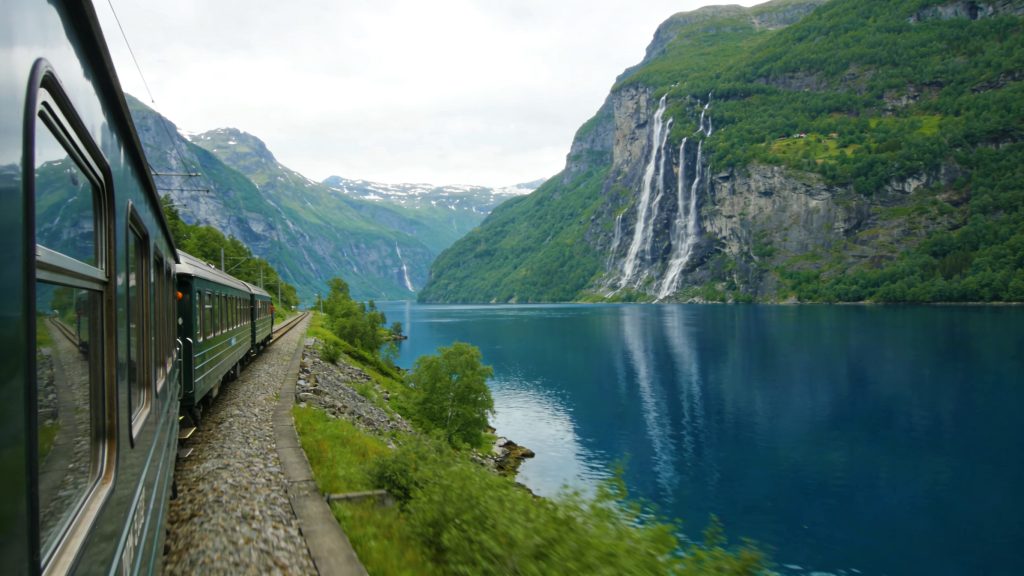
Norway brings together fjords, mountain passes and waterfalls in short, intensive train journeys, turning the journey itself into the destination. The Flåmsbana between Flåm and Myrdal is the best-known example. It is a technical masterpiece that climbs 865 metres in one hour through a landscape many travellers describe as spectacular. This route works best as part of a wider tour of western Norway, where you cleverly combine trains, fjord cruises and mountain lines.
What makes the Flåmsbana special?
The Flåmsbana connects Flåm, on a side arm of the Sognefjord, with the mountain station Myrdal on the Bergensbanen. The route is around 20 kilometres long and takes about an hour. Over that distance the train climbs 865 metres, making the route one of the steepest normal-gauge railway lines in the world. The combination of fjord level, mountain valleys, tunnels and views of waterfalls makes this one of the most beautiful train journeys in Norway.
The route was built as a technical showpiece and dates from a time when mountain railways were still constructed by hand. You can see this in the many bends and tunnels the train takes to gain height. For travellers this mainly means a lot of variety in a short time. You sit by the window and watch the landscape quickly change from green fjord valley to bare mountain plateau.
In practice, the Flåmsbana is geared towards tourists. Most passengers make a return trip and the train shuttles back and forth between Flåm and Myrdal throughout the day. This makes the ride worthwhile in its own right, but also ideal as part of a longer journey where you change at Myrdal onto the scenic rail line between Oslo and Bergen or continue your route towards fjords and coastal areas.
‘ The contrast with the green fjord valley is striking and that makes the journey visually powerful. ’
Where does the Flåmsbana run and what do you see?
The train departs from Flåm, a small village on the Aurlandsfjord. This is a branch of the Sognefjord, the longest and deepest fjord in Norway. The starting point lies practically at sea level. From here the train climbs through the Flåmsdalen, a narrow valley with steep slopes, green meadows and farms that are lush and green in summer.
One of the highlights is the Kjosfossen waterfall, where the train makes a brief stop. Passengers can get out to take photos. The waterfall cascades down in several tiers and is particularly impressive in spring and summer due to meltwater from the mountains. After the stop, the journey continues uphill, through tunnels and over viaducts, until you arrive in Myrdal.
Myrdal is a mountain station at over 860 metres above sea level. There is little here besides the station and the connection to the Bergensbanen. The view is bare and rugged, with rocks, snow and sparse vegetation. The contrast with the green fjord valley is striking and that makes the journey visually powerful.
Combining the Flåmsbana with other routes
The Flåmsbana works best as a link in a longer journey through Norway. Many travellers choose a combination where they travel from Bergen or Oslo to Myrdal on the Bergensbanen, change there to the Flåmsbana and then from Flåm either take a fjord cruise or continue on to other destinations in the fjord region.
The Bergensbanen between Oslo and Bergen is one of Norway’s longest and most beautiful railway lines. The route takes about seven hours and runs through mountain landscapes, over the Hardangervidda plateau and past lakes and valleys. Myrdal lies roughly halfway, making it easy to include the Flåmsbana as a side trip.
Another popular combination is to end your train journey with a boat trip on the Sognefjord or the Nærøyfjord. The Nærøyfjord is a narrower and more dramatic side fjord that is on the UNESCO World Heritage List. From Flåm, fjord cruises depart daily that take you to places such as Gudvangen or Aurland. From there you can continue by bus or car or return to your starting point.
Practical tips for combination travellers
- Book your train tickets and fjord cruise in advance, especially in the peak season between June and August.
- Allow enough transfer time in Myrdal, especially if you are travelling with luggage.
- If you are travelling with an Interrail pass, check the conditions: you get a discount on the Flåmsbana, but reservations for individual travellers are limited.
- Choose a window seat and stay alert: many views are brief and pass quickly.
Other spectacular train routes in Norway
Besides the Flåmsbana, Norway has more railway routes that pass through impressive landscapes. These lines are often longer and less touristy, but offer the same combination of mountains, fjords and wide views.
The Bergensbanen
The Bergensbanen between Oslo and Bergen is Norway’s best-known long-distance line. The route crosses the Hardangervidda, the largest mountain plateau in Europe. You travel through barren high plains, past glacial lakes and through tunnels hewn deep into the mountains. The line is often cited as one of the most beautiful railway routes in the world and is ideal for travellers who want a longer, more leisurely train journey.
The Dovrebanen
The Dovrebanen connects Oslo with Trondheim and runs through the Dovrefjell mountains. This area is known for its rugged nature and the presence of musk oxen. The route is less touristy than the Bergensbanen, but offers similar landscapes with mountains, forests and valleys.
The Nordlandsbanen
The Nordlandsbanen runs from Trondheim to Bodø, crossing the Arctic Circle. This is one of Norway’s longest train journeys and takes around ten hours. The line follows the coast in parts and continues through forests and over mountain passes. In summer it stays light for a long time and you can enjoy the midnight sun effect.
‘ For travellers looking for peace and wintry atmospheres, this season is ideal, but the logistics require more planning. ’
Best season for train journeys in Norway
The season has a big impact on your train journey through Norway. Most travellers opt for summer, between June and August. In this period there are more trains, the days are long and the landscape is green and lush. Waterfalls carry a lot of water from melting snow and glaciers. It is also the busiest time of year, so you need to book early and be prepared for full trains and higher prices.
In autumn, from September to October, the colours become more intense. The mountains turn red and yellow and the crowds decrease. Weather conditions are changeable, but train journeys are quieter and cheaper. The Flåmsbana runs less frequently, so check the timetable beforehand.
Winter, from November to April, offers a completely different picture. The landscape is covered in snow and the light is low and soft. The Flåmsbana runs less often in this period and some fjord cruises are not available. For travellers looking for peace and wintery atmospheres, this season is ideal, but the logistics require more planning.
Spring, between April and May, is the least popular season but offers the greatest natural dynamism. Melting snow creates powerful waterfalls and the amount of daylight increases rapidly. Timetables are still limited and some mountain roads are still closed, so expect less flexibility in your itinerary.
Practical information for your fjord train journey
The Flåmsbana is owned by a separate operator and uses its own fare structure. You can buy tickets online or at the station. In peak season it is wise to book in advance, especially if you are travelling with a group or want to secure specific departure times.
Interrail pass holders receive a discount, but individual travellers cannot make seat reservations. Reservations are only possible for groups of ten or more. This means that in busy periods you may have to wait for a later train.
The train has large windows and most seats offer good views. There is no restaurant car on board, so bring your own food and drink if you plan to spend the day in the region. There are shops and restaurants in Flåm, but prices are high.
The route is accessible to travellers with reduced mobility, but boarding can sometimes require assistance. Check with the operator in advance if you need specific facilities.
Discover more on Traveler Tips
Fjord train journeys are a unique way to explore Norway. There is much more to discover about train travel, routes and preparation. On the Traveler Tips website you will find extensive information about destinations, planning tips, regulations and the most beautiful itineraries across Europe. Whether you choose a short train ride or an extended tour, the website helps you travel smarter and more consciously.
Frequently asked questions
The most efficient way is to fit the Flåmsbana in between Oslo and Bergen via the Bergensbanen, with a change in Myrdal (for example Oslo–Myrdal–Flåm–Myrdal–Bergen or the other way round). Combine the journey from Flåm with a fjord cruise on the Sognefjord/Aurlandsfjord and possibly an overnight stay in Flåm for hikes or kayaking trips. For an intensive road trip experience, you can hire a car in Flåm and drive via the Aurlandsfjellet (the “Snow Road”) or the E16 to spectacular mountain passes and viewpoints, then rejoin the rail route afterwards. In peak season, plan well in advance and coordinate train times, fjord cruises and driving distances closely to minimise waiting times and maximise the overall experience.
In peak season, book as early as possible and match your tickets to the seasonal timetable, as trains fill up quickly in summer and there are fewer services in winter. Choose window seats deliberately for the best views and allow enough transfer time if you are combining the fjord train journey with connecting routes such as the Bergensbanen or a fjord cruise. When budgeting, take into account seasonal prices, the often touristy nature of the route (few genuinely “cheap” options) and any Interrail discounts or reservation rules. Consider building the journey into a longer trip so that the relatively high ticket price delivers more value within your overall travel experience.
Along the Flåmsbana, the highlights include the deep Aurlandsfjord, steep mountain walls, countless waterfalls and the large difference in altitude that you cover in a short time. Expect many photo moments at waterfalls, winding sections of track with views over the valley, and the transition from fjord level to rugged high mountains. A well-known photo stop is the halt at the large waterfall (with viewing platform) where the train pauses briefly. On other fjord train routes such as the Bergensbanen, the best photo opportunities are often on the high plateau between Oslo and Bergen, where you have wide panoramas, lakes and barren mountain landscapes.
The best time to travel for fjord train journeys such as the Flåmsbana is roughly from late spring to early autumn (May–September), with May, June and September often offering a good balance between great views and fewer crowds than in the high season of July–August. In summer the days are long, more trains run and the fjords are green, but it is also the busiest time and reservations are strongly recommended. In winter it is much quieter and the snow-covered mountain scenery can be spectacular, but significantly fewer trains run and weather conditions can affect visibility and timetables. In spring and autumn you need to be prepared for changeable weather, but you often get clear light and fewer tour groups.